A rural lot listed for $180,000 can easily need $50,000 to $90,000 of water, sewage and power work before the first wall goes up. Most first-time acreage buyers learn this from the well driller's quote, not from the listing. Servicing a lot outside the city has a clear order, and following it saves money and protects your house design.
This guide walks through that order for Canada, with 2025 cost ranges in CAD. It also compares Canada with the United States, Germany and Poland. The rules there are different, but the reasons behind them help explain why Canadian rules work the way they do.
Step 1: Find out what the lot really has
Before you buy, or at least before you design, call the municipal planning or building department. Ask four questions:
- Is there a municipal water main or sanitary sewer on the road, and is connection required?
- How far away is the nearest three-phase or single-phase hydro line?
- Is natural gas available on the road?
- Does the lot fall under a conservation authority or regulated area?
Ask the seller for any old well records or septic permits. Provincial well records are often searchable online.
Time: 1 to 3 weeks. Cost: usually free, or a few hundred dollars for a formal compliance letter.
How this compares abroad: in Germany, most building land is fully serviced (erschlossen) before it is sold. Where a public sewer exists, connection is generally mandatory. Polish and Romanian rural plots are often sold "with electricity at the fence" and nothing else, which is closer to the Canadian acreage experience.
Step 2: Test the soil before you fall in love with a site
Your septic design depends on the soil. A designer or engineer digs test pits and checks the percolation rate (the T-time in Ontario terms). They also check the depth to bedrock and the seasonal high water table.
The results decide how your sewage is treated:
- Sandy, well-drained soil usually allows a conventional system.
- Clay, shallow rock or a high water table often means a raised bed or a treatment unit, which can cost twice as much.
Time: 1 to 4 weeks, but frozen ground can push it to spring. Cost: about $1,000 to $3,500 in 2025.
The American "perc test" works the same way and is run through the county health department. Canada's process is similar, but who signs off depends on the province:
- Ontario: systems are permitted under Part 8 of the OBC.
- British Columbia: a registered onsite wastewater practitioner files the design with the health authority.
- Quebec: the municipality issues the permit under provincial regulation.
Step 3: Choose the sewage system
Canadian homeowners usually pick from three options:
| System | Typical installed cost (2025, CAD) | When it fits |
|---|---|---|
| Conventional septic tank and leaching bed | $15,000 to $35,000 | Good soil, enough flat area |
| Raised or partially raised bed | $25,000 to $45,000 | Shallow soil or high water table |
| Tertiary treatment unit with smaller bed | $30,000 to $60,000+ | Small lots, poor soil, near lakes |
| Holding tank | $10,000 to $20,000 plus pump-outs | Rarely allowed for new homes, mostly seasonal |
Germany pushes hard toward treatment rather than simple storage. A Kleinkläranlage must be an approved type, needs a water-law permit, and comes with mandatory maintenance visits.
Poland's long-running debate, szambo czy przydomowa oczyszczalnia, is the same choice Canadians face:
- A holding tank is cheaper to install but expensive to empty for decades.
- A small treatment plant costs more up front but runs cheaply.
Canada's cold climate adds a factor the others feel less: tanks and lines must sit below frost or be insulated. Snow cover over the bed should not be compacted by driveways or snowmobile paths.
Plan for one thing early. In most provinces, the size of the system is tied to the number of bedrooms and fixtures, along with the floor area. A five-bedroom bungalow such as this 1692 sq ft Modern Craftsman with 5 bedrooms will need a larger tank and bed than a three-bedroom house of the same size. Price the septic system for the plan you actually intend to build.
Step 4: Decide on water, drilled well or municipal connection
If there is no main on the road, you will most likely need a drilled well. In much of Canada, a well is drilled 100 to 300 ft deep with a steel casing.
- Drilling: priced per foot. In 2025, a finished well with pump, pressure tank and line to the house usually lands between $12,000 and $30,000. Deep or dry holes cost more.
- Treatment: add $1,500 to $8,000 for a softener, UV, or iron and sulphur filtration, depending on the water test.
- Municipal connection, if available: often $5,000 to $25,000 once you add development charges and the service trench. Check the current fee schedule with your municipality.
Private drinking-water wells are uncommon in Germany, and most rural houses are on the public network. Wells are common on Polish and Romanian plots, though often as a secondary garden supply. Canada is closer to the rural US here: the well is the house's main water source, so its yield and quality are a real deal-breaker.
Time: drilling itself takes 1 to 3 days, but booking a driller in spring can take 4 to 12 weeks. Always order a lab water test before you finish the design.
Step 5: Line up hydro and heating fuel
Ask your local distributor for a connection estimate early. Distributors include Hydro One, BC Hydro, Hydro-Québec and local utilities.
- Short service drop: a house near the road on an existing line may pay a few thousand dollars.
- Long run: a home set 200 m back, or one needing new poles or a transformer, can face $15,000 to $50,000 or more.
Natural gas is often not on rural roads. Many acreage homes therefore combine a cold-climate heat pump with propane or electric backup. A leased propane tank has its own setback and access rules.
In Germany and Poland, the house connection (Hausanschluss, przyłącze) is a regulated application with a published or negotiated fee. Waits of several months are normal. Canadian timelines are similar, so apply as soon as you have a site plan.
Step 6: Site the house around the services, not the other way around
This is the step that most affects your plan. Before placing the house, mark these on the site plan:
- The well location.
- The septic tank and leaching bed, and in some provinces a reserve area for a future replacement bed.
- Setback distances. Separation between a drilled well and a leaching bed is commonly around 15 m (50 ft), with further distances from lakes, streams and property lines. Confirm the exact figures for your province.
- Slope. Sewage should flow by gravity from the house to the tank, then to the bed, ideally downhill and away from the well. Otherwise you pay for a pump chamber, roughly $3,000 to $8,000 more.
- The driveway and the septic pump truck route. Trucks need access, but must never drive over the bed.
The utility room follows from that layout. The water line from the well and the building drain to the tank should enter and leave on the same side of the house. This keeps trenches short and shallow runs out of frost.
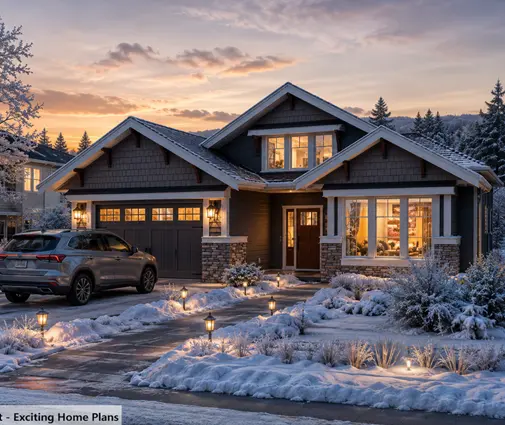
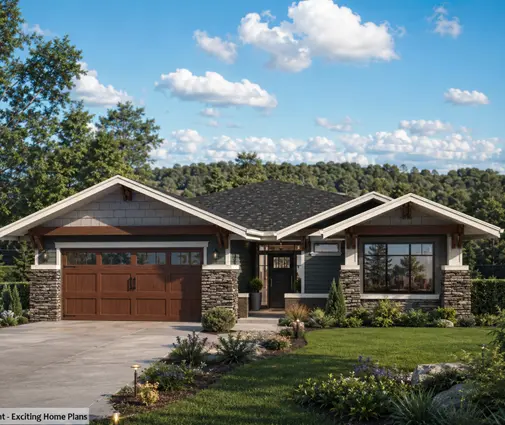
A full basement makes this easy because there is space for the pressure tank, treatment equipment, HRV and heat pump air handler. That is one reason house plans with a basement dominate rural Canadian builds. This 4-bedroom Craftsman bungalow of 1649 sq ft and this Modern Mountain one-storey of 1584 sq ft both have a full basement for that mechanical core.

Step 7: Choose a plan that suits the servicing
On an acreage, a one-storey layout spreads plumbing over a wider footprint. Look for plans where the kitchen, laundry and bathrooms cluster on one side, over the future mechanical room.
If the soil means a raised bed or shallow rock rules out a deep basement, a slab or crawlspace house needs a dedicated mechanical room on the main floor. This 3-bedroom farmhouse ranch of 1707 sq ft without a basement and this 1706 sq ft modern farmhouse with 3 bedrooms are good starting points. Both fit the style many rural families want, and you can browse more in the farmhouse collection.
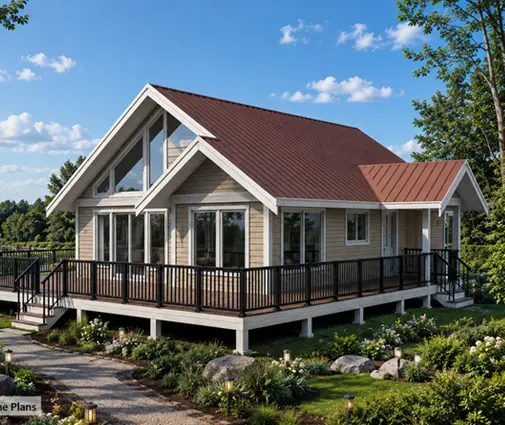
For a seasonal property, a smaller system is often enough if local rules allow it. This 975 sq ft, 2-bedroom lake cottage keeps fixtures to a minimum.


Step 8: Permits, installation and inspection
In most provinces, the septic permit comes before, or together with, the building permit. Typical sewage permit fees run from several hundred to about $2,000.
The usual installation order is:
- Drill the well early so you have construction water.
- Install the septic system after the heavy machinery is done, so the bed area is not compacted.
- Run hydro during framing.
The inspector must see the septic system before backfill. Keep the as-built drawing for future buyers and pump-outs. Germany's mandatory maintenance contracts are not universal in Canada. Even so, plan to pump the tank every 3 to 5 years and service any treatment unit as its approval requires.
Timeline at a glance
| Step | Typical duration | Typical cost, 2025 (CAD) |
|---|---|---|
| 1. Servicing check with municipality | 1 to 3 weeks | $0 to $500 |
| 2. Soil and percolation assessment | 1 to 4 weeks (not in frozen ground) | $1,000 to $3,500 |
| 3. Septic design and selection | 2 to 6 weeks | $15,000 to $60,000+ installed |
| 4. Well drilling and water testing | 4 to 12 weeks incl. booking | $12,000 to $30,000 plus treatment |
| 5. Hydro and fuel applications | 2 to 6 months | $2,000 to $50,000+ |
| 6. Site plan with setbacks | 1 to 3 weeks | Included in design fees |
| 7. Plan selection and adaptation | 2 to 8 weeks | Varies |
| 8. Permits, install, inspection | 1 to 3 months | $500 to $2,000 in permit fees |
The bottom line for a Canadian family is to budget services as a separate line, often 15 to 30 percent of the shell cost on a raw acreage. Test the soil and the water before finalizing the design, and let the well and septic system decide where the house sits. Costs and setbacks vary widely by province and municipality, so confirm current rules with your building department or health unit and a licensed installer before you sign anything.