Most people who search for grants for building a house in Ontario expect a cheque from the government. The short answer is that almost nothing for new construction is a true grant. Most of the money comes back as tax rebates. These include the federal and Ontario HST new housing rebates, the federal GST relief for first-time buyers of new homes, and a partial refund of your mortgage insurance premium through CMHC Eco Plus if the house is energy efficient. On a typical family home in 2026, those rebates can add up to more than $50,000. That is real money, but only if you know which forms apply to you and file them on time.
The questions below are the ones Ontario builders and owner-builders ask most often. The figures reflect the rules as of late 2026. Rebate programs change with federal and provincial budgets, so confirm the current details with the Canada Revenue Agency, your lender or a tax professional before you count on any amount.
Are there actual grants for building a house in Ontario, or only rebates?
For a new house, it is mostly rebates. The federal Greener Homes Grant, which many people still remember, closed to new applicants in 2024, and it covered retrofits of existing homes, not new builds. Most provincial and utility energy programs work the same way. What is left for new construction is tax relief: you pay HST on the house or on its materials and labour, and part or all of it comes back.
Because of that, a realistic budget treats rebates as a refund that arrives after completion, not as money in hand during construction. Your construction lender will expect you to carry the full HST until then.
How much HST do the standard new housing rebates return?
For a buyer who does not qualify as a first-time buyer, the Ontario portion of the rebate is the one that matters. It returns 75% of the 8% provincial share of HST, up to a maximum of $24,000, and it has no price cap. Almost every new Ontario home therefore gets the full $24,000.
The federal portion is much smaller. It returns up to $6,300 of the GST and phases out completely once the home's value reaches $450,000. With today's land and construction costs, very few new homes in southern Ontario fall under that limit. Both rebates require the house to be your primary residence or that of a close relative.
What changed for first-time buyers of new homes?
Since 2025, first-time buyers can get the entire 5% GST back on a new home worth up to $1 million, which is up to $50,000. The relief shrinks gradually between $1 million and $1.5 million and ends above that. In general, you qualify as a first-time buyer if neither you nor your spouse or common-law partner lived in a home that either of you owned in the current year or the four years before. The new relief replaces the small federal rebate. It does not add to it.
In fall 2025, Ontario announced that it would match the federal relief by removing the provincial portion of HST for first-time buyers of new homes up to the same $1 million value. That would roughly double the benefit. The start dates and conditions matter, including whether the provincial relief covers owner-built homes, so check the final rules with the Ontario Ministry of Finance or the CRA before you sign a contract.
Does a house I build myself qualify for the rebates?
Yes. Canada has a separate owner-built homes rebate for people who build on their own land or hire a contractor to do it. You claim back the GST/HST you paid on the land, if any, and on construction. For the federal first-time buyer relief, construction generally has to have started on or after May 27, 2025. The Ontario rebate is available to owner-builders too.
The catch is that the rebate is calculated on the value of the finished home with the land included. On an expensive lot, a modest house can push the total past the $1 million threshold. A compact design keeps you under it more easily. A modest bungalow of 1362 sq ft with a full basement gives a family three bedrooms and leaves room in the budget for the lot.
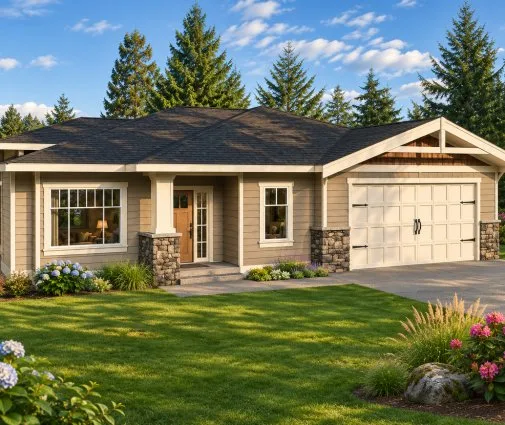


If the rebate thresholds are shaping your budget, browse our three-bedroom house plans. They are filtered to the size most families build, and you can sort them by area.
Can I get Ontario heat pump rebates on a new build?
Usually not. Ontario's home energy rebates, delivered through Enbridge Gas and Save on Energy, are designed for upgrading existing homes. Most of them require an existing home, an energy assessment before the work and an assessment after it. A house that is still being framed has no "before."
New construction is handled differently. Utilities run programs aimed at builders, and some offer incentives for homes that exceed the Ontario Building Code's energy requirements. If you hire a contractor, ask whether they are enrolled in one. Your gain from a cold-climate heat pump on a new build is mostly lower bills, plus help qualifying for CMHC Eco Plus. A single-storey layout with a simple roofline, like this 1577 sq ft Craftsman-style ranch, is easier to heat and cool with one ducted heat pump than a sprawling footprint.
What is CMHC Eco Plus and who qualifies?
CMHC Eco Plus refunds up to 25% of your mortgage loan insurance premium if the home is energy efficient. It only applies if your mortgage is insured with CMHC, which normally means a down payment under 20%. Since late 2024, first-time buyers and buyers of new builds can get insured mortgages with 30-year amortizations, on homes priced up to $1.5 million.
A new home generally qualifies if it is certified under a recognized program such as ENERGY STAR for New Homes, R-2000 or Net Zero, or if an energy model shows it performs better than code by the required margin. You must apply within 24 months of the mortgage closing. Plan the energy modelling while the house is still on paper: higher R-values in the walls and attic, an airtight envelope, an HRV and a heat pump are much cheaper to include than to add later.
Can I use my FHSA and RRSP to build instead of buy?
Yes. Both the First Home Savings Account and the RRSP Home Buyers' Plan allow withdrawals for a home you are going to build, not just one you buy. The FHSA lets you take out up to $40,000 in contributions plus growth, tax-free. The Home Buyers' Plan lets each person borrow up to $60,000 from their RRSP. A couple can combine both, which often covers the down payment on the lot.
The timing rules are strict. The house generally has to be built and occupied by October 1 of the year after the withdrawal. Owner-builders lose time to permit delays and winter, so do not withdraw the money until your municipal building permit is in hand and your schedule is realistic.
How do the rebates stack on a typical three-bedroom house?
Take a couple of first-time buyers building a one-storey, three-bedroom home with a full basement. They pay $250,000 for a lot from a private seller, so no HST applies to the land. They pay $600,000 plus HST to a contractor. The finished home is worth about $950,000. The illustrative 2026 figures look like this:
| Item | Amount (CAD) | Notes |
|---|---|---|
| HST paid on construction (13%) | about $78,000 | $30,000 GST plus $48,000 provincial portion |
| Federal first-time buyer GST relief | about $30,000 | All the GST paid, because the value is under $1 million |
| Ontario new housing rebate | $24,000 | Or up to the full $48,000 if the provincial first-time buyer relief applies |
| CMHC Eco Plus | a few thousand dollars | Only with an insured mortgage and an efficient home |
| FHSA plus Home Buyers' Plan | up to $200,000 for two people | Not a rebate, but tax-free access to savings |
Without first-time buyer status, the same couple would receive about $24,000. With it, they would receive $54,000 or more. That difference is worth confirming before you choose a lot. A larger two-storey home of 2240 sq ft on the same lot could push the value toward $1.1 million, where the federal relief starts to shrink.


When do I apply for each rebate?
When you buy from a builder, the builder usually credits the HST rebates on the closing statement, and you assign the rebate to them. When you build yourself, you apply to the CRA after the work is finished. The deadline is generally two years from the earlier of moving in or substantial completion. Keep every invoice that shows HST, because the CRA can ask to see them.
Apply for CMHC Eco Plus through your lender or CMHC after you receive the energy certificate or evaluation, and within 24 months of closing. FHSA and Home Buyers' Plan withdrawals happen before or during construction, with forms submitted to your financial institution.
What mistakes cost people their rebate?
The most common mistakes are:
- Cash deals with no receipts. HST you cannot document is HST you cannot claim.
- Underestimating the land. The value threshold includes the lot, so a costly lot can cut the relief.
- Starting construction too early. The first-time buyer relief depends on construction or contract dates.
- Not living in the home. All of these rebates require it to be a primary residence.
- Missing the two-year deadline. Owner-builders often finish the basement years later and forget to file in time.
A smaller footprint helps on every count. It costs less, it keeps the value under the thresholds and it makes efficiency targets easier to reach. A compact cottage like this 1077 sq ft chalet with three bedrooms can work on a rural acreage, and a 1207 sq ft single-storey layout suits a suburban lot. To compare more options with the rebate rules in mind, start with our 3 bedroom plans or narrow the list to one-storey homes.