The ice storm takes down the lines at two in the morning. By breakfast the house is at 16°C, the heat pump is silent, and the only warm room is the one with a wood stove. Many Canadian families have lived that scene, and it shapes how we plan a hearth differently from families in other countries. In 2026 most new fireplaces are bought for atmosphere, yet in Canada the backup role still matters. Below are the questions people ask most when they plan one, with a look at how the United States, Germany, Poland and the Baltic states handle the same choice.
Is a fireplace in a new Canadian house still about heat?
Mostly no, but more so than in most of Europe. A new home built to current energy codes, with an air-source or cold-climate heat pump and an HRV, does not need a hearth to stay warm. What it may need is a heat source that works without the grid. In rural Ontario, Quebec, the Maritimes and much of BC, outages of a day or more after storms are a real possibility, and a wood stove is the simplest answer.
In Germany and Poland the hearth is chosen almost entirely for comfort and evening ambiance. In the United States, especially in the suburbs, it is often a design feature on a TV wall. Canada sits in between: the living room fire is about mood on a weeknight and about survival during a blackout.
Why do Canadians lean toward wood stoves while Americans prefer gas fireplaces?
Because the American default is convenience and the Canadian rural default is independence. A typical new American subdivision home gets a direct-vent gas fireplace on an exterior wall: a sealed glass front, a coaxial vent through the siding, a wall switch or remote. It is clean, cheap to frame and needs no chimney.
Canadian suburban builders install the same direct-vent gas units, and they are popular in Ontario and Alberta subdivisions. But on acreages and at the cottage, where natural gas often is not available and propane deliveries cost more, a certified wood stove wins. Note that many modern gas fireplaces need electricity for their fan or ignition; some models have a battery or standing-pilot option that keeps them running in an outage. Ask before you buy if backup heat is the goal.
What does "EPA-certified" mean here, and how does it compare with Germany's rules?
It means the stove passed a particulate emission test, and in Canada that is usually the US EPA 2020 limit or the Canadian CSA B415.1 standard. Several provinces and cities restrict uncertified appliances, and some municipalities, including parts of Quebec, have bylaws that limit or ban wood burning that does not meet a certified standard. Rules change, so check with your municipality before you choose a model.
Germany is stricter and more systematic. A Kaminofen sold there must meet the limits of the federal emission ordinance (the 1. BImSchV), and a licensed chimney sweep inspects and measures it on a schedule. Older stoves that did not meet the limits had to be retrofitted or retired by set deadlines. Canadians do not have the chimney sweep inspection system, which is exactly why it pays to have your installation checked by a WETT-certified professional (the wood energy technical training program used across Canada) and to confirm what your insurer requires.
What is a Polish "kominek" and why does it always have a closed insert?
A kominek is the classic Polish fireplace: a masonry or board-clad surround built around a cast-iron or steel firebox with a glass door, the wkład kominkowy. Open fireplaces have almost disappeared there, because many regions adopted anti-smog rules that allow only appliances meeting EU ecodesign standards.
For a Canadian family the lesson is useful: an open masonry fireplace looks romantic but sends most of the heat up the chimney and pulls warm air out of a tight house. A wood-burning insert with a door, built into a custom surround, gives you the look of a built-in fireplace with the efficiency of a stove. It is a good choice for a modern great room where a freestanding stove feels too rustic.
Could a Baltic-style masonry heater work in a Canadian house?
Yes, and Canada has a small but serious community of builders who make them. In Estonia, Latvia and Finland a masonry heater is a heavy mass of brick or stone with internal channels; you burn a hot, fast fire once or twice a day and the mass releases heat for many hours. It often stands between the living room and the kitchen, sometimes with a bench or a cooking surface, and the family sauna sits nearby with its own wood-fired stove.
The catch is weight and cost. A masonry heater can weigh several tonnes, so it needs its own footing, which is easier in a house with a full basement where the foundation can be designed for it from the start. It also has to be in the centre of the house, not on an outside wall. If you want one, decide before the foundation drawings are done.
Where should the chimney go in the living room layout?
On an interior wall or near the centre of the house, whenever you can. A flue that runs inside the heated envelope stays warm, drafts better on cold starts and loses less heat than one running up the outside of an exterior wall. It also exits close to the ridge, which makes the clearance rule easier: a chimney generally has to rise at least 3 ft above where it leaves the roof and 2 ft above anything within 10 ft. Check the exact numbers for your appliance with the installer and your local code.
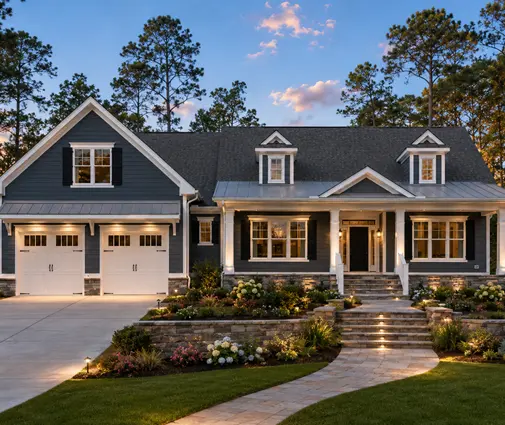
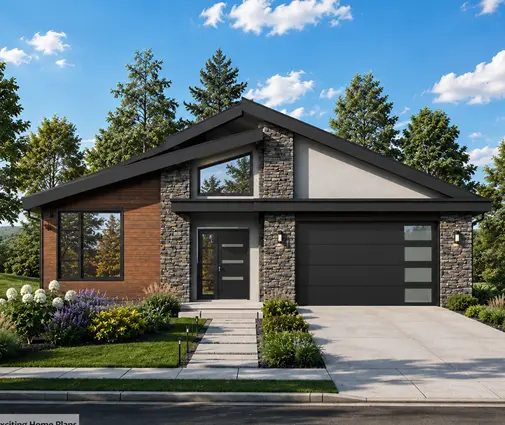
In practice, look for an open great room with one solid wall that is not full of windows or doors, and enough floor space in front for the hearth pad and the clearances to furniture. This five-bedroom Craftsman bungalow of 1607 sq ft with a basement and this three-bedroom mountain-style one-storey of 1899 sq ft both have a central living area where a stove or insert could anchor the room. A basement also lets you run a flue straight up, or put a second stove downstairs for a rec room.


Can an airtight or Step Code home have a wood stove?
Yes, if the stove is designed for it. Houses built to the BC Energy Step Code upper steps, or to a net-zero or Passive House standard, are so tight that a stove drawing room air can backdraft when a range hood or dryer runs. The answer is the same in Germany, where very efficient houses use room-sealed stoves (raumluftunabhängig): choose a model with a direct outside combustion air connection, sealed doors, and a size matched to a small heating load.
Size matters more than people expect. A big stove in a tight 1,600 sq ft bungalow will overheat the room and be run smouldering, which is dirty and inefficient. Ask your designer for the heat loss of the house and pick the smallest certified stove that fits. Coordinate with the HRV designer too, and plan make-up air for a powerful range hood.
How much does a hearth cost in Canada in 2026?
Expect a wide range, roughly as follows in 2026, installed and before taxes. Prices vary a lot by province, brand and the height of the chimney.
| Option | Typical installed cost (CAD, 2026) |
|---|---|
| Electric fireplace or insert | $500 to $3,500 |
| Direct-vent gas fireplace | $4,500 to $10,000 |
| Certified wood stove with insulated chimney | $5,000 to $12,000 |
| Wood insert in a custom surround | $8,000 to $18,000 |
| Masonry heater | $20,000 to $50,000 or more |
For comparison, a Polish kominek with an insert or a German Kaminofen costs less in local labour, but the chimney is often masonry or ceramic and built with the house. Our cost driver is the insulated stainless chimney through a cathedral or vaulted roof, plus the hearth protection under the stove.
When is an electric or bioethanol fireplace the honest choice?
When you want the look, have no backup heat need, and have no good place for a flue. An electric unit is the right answer for a basement suite, a bedroom, a townhouse or a home where the only free wall is exterior and full of windows. Today's models show convincing flames, add some heat with a fan, cost almost nothing to install and need no venting.
Bioethanol units are vent-free, which sounds attractive, but they release water vapour and combustion gases into the room, and the flame is real. Use only a certified unit, follow the room size limits, keep it well away from children, and check with your local fire department before you buy. Neither type will help during a power outage.
Which house plans have room for a hearth?
Look for single-storey plans with an open living room, a clear interior wall and a full basement if you want a straight chimney run or a heavy masonry heater. Browse the one-storey plans, filter for a basement, and favour an open-concept layout so the fire is visible from the kitchen and dining area.
A few examples: the four-bedroom lake-style modern plan of 1588 sq ft with a basement suits a sleek wood insert; the three-bedroom Scandinavian one-storey of 2168 sq ft fits a freestanding stove in the spirit of Nordic homes; the three-bedroom modern farmhouse ranch of 1706 sq ft works on an acreage with a wood stove as backup heat; and the compact three-bedroom bungalow of 1384 sq ft shows that a small stove can be the heart of a modest home.


Whatever you choose, place the hearth on the plan before the framing drawings are final, and have the installation reviewed by your municipality and a certified installer.