Imagine handing your builder the final cheque, moving in, and three weeks later finding a lien from the drywall supplier on your title. You paid for that drywall once, but the law may let the supplier claim it from your land. This is the situation the holdback system in Canada is meant to prevent, and it only protects owners who follow it. Here is how one typical family in Ontario got through their build, chapter by chapter, and what they learned about construction liens on the way.
Chapter 1: A lot, a plan and a budget that forgot something
The family, two working parents with two school-age children, bought a half-acre lot at the edge of a mid-sized town in eastern Ontario. Municipal water, a septic system, and a frost line deep enough that a full basement made sense: the excavation was needed anyway, so the extra living space came cheaply.
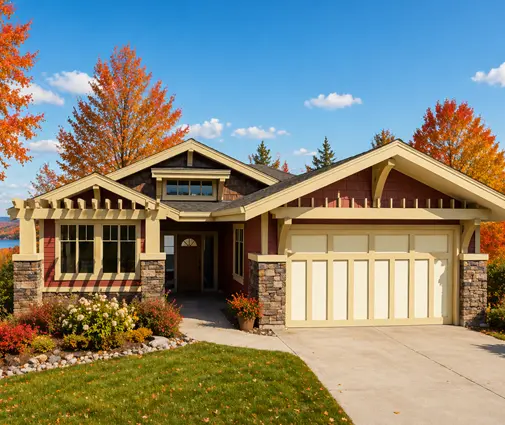
They looked at several floor plans. A compact 1,292 sq ft three-bedroom bungalow fit the budget easily but left no room to grow. A Craftsman one-storey plan of 1,722 sq ft with a basement and a three-car garage appealed because it kept every daily room on one floor. They also considered a five-bedroom Craftsman of 2,186 sq ft with a basement for future guests. In the end they chose a Modern Craftsman of 1,995 sq ft with three bedrooms, 3.5 baths, a two-car garage and a basement, which balanced the room count against the cost of heating and the cost of building.


Their builder quoted a fixed price of about $780,000 including HST for the house, which in 2025 put them at roughly $390 per square foot of finished space, in the range many custom builds in Ontario landed. What the budget did not show was that 10% of that, around $78,000, would legally have to stay in their hands for weeks after the house was finished.
Lesson: when you compare plans in the homes with a basement category or anywhere else, budget for the holdback too. It is not an extra cost, but it changes when cash moves, and both you and your builder need to plan for that.
Chapter 2: Learning what a lien is before signing
Their real estate lawyer, who handled the lot purchase, explained the basics in one meeting. Under Ontario's Construction Act, anyone who supplies work or materials to improve land, such as a framer, an electrician or a lumber yard, can register a lien against the property if they are not paid, even if they had no contract with the owner. The owner's protection is the holdback: retain 10% of the value of the work as it is done, and in most cases the owner's exposure to the unpaid subcontractors is limited to that holdback.
Other provinces use the same idea under different laws. British Columbia has the Builders Lien Act, Alberta has the Prompt Payment and Construction Lien Act, and Saskatchewan, Manitoba and the Atlantic provinces have their own lien statutes. Percentages, deadlines and whether the holdback must sit in a separate account differ, so an owner in Kelowna or Red Deer needs the local rules, not Ontario's. Quebec works differently under the Civil Code, with legal hypothecs and notices of contract to the owner.
The lawyer also warned that receiving written notice of a lien from a subcontractor changes things: from that moment the owner must also hold back enough to cover that specific claim, beyond the basic 10%.
Lesson: the holdback is your legal shield, not a negotiating tactic. Pay out 100% of each invoice and you may lose the protection and end up paying some trades twice. Ask a lawyer in your province how the rules apply to your contract.
Chapter 3: Putting the protection into the contract
The builder's standard contract was a few pages long. With the lawyer's help the family added clauses that most builders who work this way accept without argument:
- Holdback: a statement that the owner retains 10% of every progress payment, as the Act requires, until the lien period expires and the title is clear.
- Draw schedule: payments tied to clear stages, such as footings and foundation, framing and roof, closed-in, mechanicals and drywall, and completion, with a site check before each payment.
- Proof of payment: before each draw, a statutory declaration from the builder that subcontractors and suppliers have been paid for the previous stage.
- WSIB: a current clearance certificate, so the family would not be pulled into unpaid workplace insurance premiums.
- Substantial performance: how and when it is certified or declared, since the lien clock starts there.
- Deficiencies: a separate amount for unfinished items, independent of the holdback, so the two are never confused.
Ontario's Act also includes prompt payment rules for invoices on construction contracts. The lawyer recommended that the contract describe what a "proper invoice" from the builder must contain, so payment deadlines would be clear on both sides.
Lesson: the contract is where you turn the law into a routine. A statutory declaration with every draw costs the builder ten minutes and gives you a paper trail if a trade later claims they were never paid.
Chapter 4: Draws, the lender and a title search every time
The family financed the build with a construction mortgage, a loan advanced in draws instead of all at once. Their lender sent an inspector or asked for a cost-to-complete report before each advance and released money in line with the percentage of work done. Like many lenders, it also kept its own holdback, so the bank's advances and the family's legal holdback had to line up. The lawyer kept a simple running sheet: value of work to date, 10% retained, amounts paid, amounts still owed.
Before every draw, the lawyer ran a search of the parcel register through Ontario's land registry system. In BC the same check is done through the Land Title Office, in Alberta through land titles, and a lawyer or registry agent can do it in any province. The search shows whether a claim for lien has been registered against the land since the last payment. A clean search, a statutory declaration and the inspector's report: only then did money move.
At the drywall stage, the search showed something. A drywall supplier had registered a lien of about $14,000 because the drywall subcontractor had fallen behind on its account. Because the family had retained their holdback and had not paid ahead of the work, the lawyer could deal with it calmly: the builder sorted out its subcontractor, the supplier was paid, and the lien was discharged from title before the next advance went out.
Lesson: search the title before every payment, not only at the end. A lien found between two draws is a paperwork problem; a lien found after you have paid everything can become your problem.
Chapter 5: Substantial performance and the 60-day clock
By late autumn the house was essentially finished: occupancy permit issued by the municipality, HRV balanced, the heat pump running, a short list of deficiencies left. The builder's work reached substantial performance, and under the Act that date mattered more than any other.
For contracts governed by Ontario's current Act, liens generally must be preserved within 60 days of key dates such as the publication of the certificate or declaration of substantial performance, or the completion or abandonment of the contract. In BC the general period is 45 days after a certificate of completion or the end of the work, and in Alberta most claims have 60 days, with some longer periods. These are the general rules in 2025; the exact triggering date for each trade can differ, which is why the family left the counting to their lawyer.
When the period had expired, the lawyer ran a final title search. It was clean. The holdback of about $78,000, minus the separately agreed deficiency amount, went to the builder. The deficiencies were fixed in the spring and that last amount followed.
Lesson: do not release the holdback on the day you move in. Wait for the lien period to end, search the title one last time, and keep deficiency money separate so your builder is not penalized for small items.
Chapter 6: Moving in with a clear title
The family moved in with a house that matched the plan they had chosen and a title that showed no claims. Looking back, the holdback had not slowed anything down; it simply set the rhythm of payments. The builder knew from the first meeting that the last 10% would arrive after the lien period, and priced and planned for it.
If you are still choosing between a Craftsman design, a modern ranch-style one-storey plan of 2,112 sq ft with four bedrooms or a classic bungalow, the payment rules will be the same once construction starts. What protects you is a good contract, a holdback you actually keep, and a title search before every cheque.
Lesson: lien laws are provincial and they change, as Ontario's did when the Construction Lien Act became the Construction Act. Before you sign with a builder, ask a lawyer in your province to confirm the current holdback percentage, the lien periods and how your lender's draw schedule fits with them.