Twelve thousand dollars or thirty thousand: that is roughly the spread you can see between insulation quotes for the same two-storey house with a full basement. The house hasn't changed. What changes is the product mix, meaning how much spray foam goes in, whether the walls get exterior rigid foam, and how the attic is done. Most of that money buys the same code-minimum R-values, so it pays to know what each option costs and where it actually earns its price.
The figures below are typical installed prices quoted across Canada in 2025 and 2026, before tax. Prices in rural areas, in the North and in hot markets like the Lower Mainland and the GTA can run higher. The required R-values depend on your province, climate zone and compliance path, so confirm the numbers with your municipality's building department or your designer before you compare quotes.
1. Fibreglass batts: the default for 2x6 walls
Most new Canadian homes still get fibreglass batts in 2x6 exterior walls, usually R-20 or R-22, behind a sealed polyethylene vapour barrier. Installed, that typically runs about $1.00 to $1.70 per square foot of wall area, including the poly and acoustic sealant. It is cheap, every crew knows it, and inspectors know exactly what to look for.
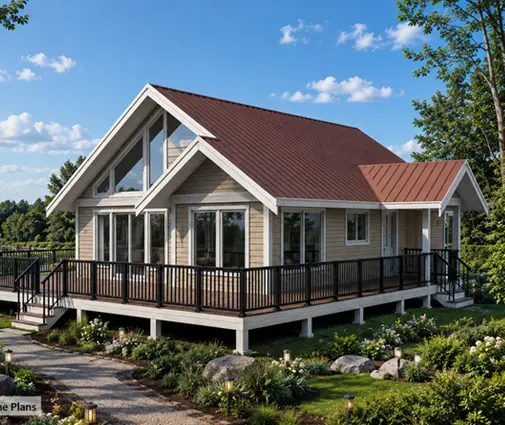
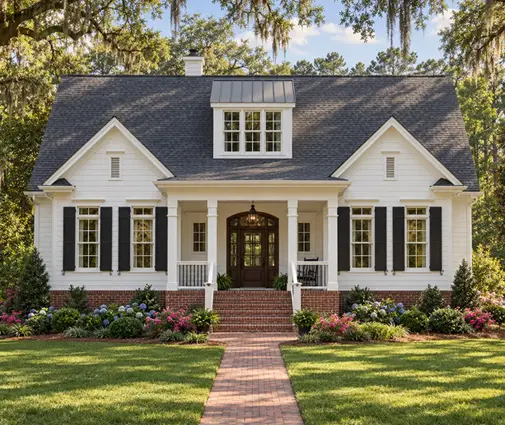
The weakness is workmanship. A batt that is compressed behind wiring, cut short around an outlet box or left gapped at the top plate loses a good part of its rated value. On a straightforward plan like this four-bedroom Craftsman of 2238 sq ft, with simple wall runs and few odd framing pockets, batts do the job well. The more jogs, bump-outs and tight corners a design has, the more time a good installer needs to fill them properly.
2. Mineral wool batts: a bit more, for fire and sound
Mineral wool (often called rock wool or stone wool) costs about 20 to 40% more than fibreglass, roughly $1.30 to $2.20 per square foot installed at R-22 to R-24 in a 2x6 wall. It is denser, friction-fits tightly, cuts cleanly around boxes and pipes, and holds up well to fire and moisture.
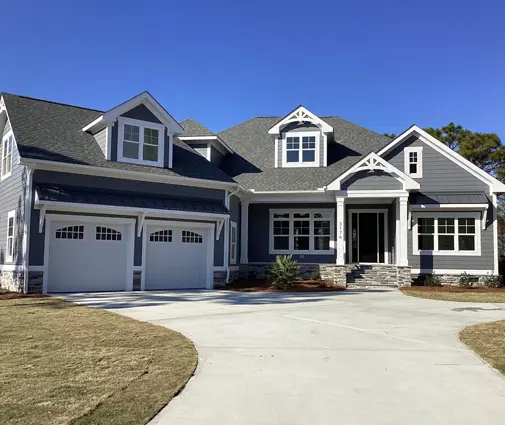
Many builders mix the two: fibreglass in exterior walls, mineral wool in interior walls around bedrooms, laundry rooms and home theatres, and in the wall and ceiling between an attached garage and living space. In a larger house like this two-storey French Country plan of 3722 sq ft with four bedrooms, sound batts in interior walls and the floor over the main living area typically add a few thousand dollars. Families often decide it is money well spent.
3. Blown-in cellulose or fibreglass in the attic
For a conventional truss attic, loose-fill is the clear winner. Blowing cellulose or loose fibreglass to R-50 or R-60 typically costs $1.30 to $2.40 per square foot of ceiling, including baffles at the eaves. Batts can't compete on price or coverage here because loose-fill fills around trusses and wiring without gaps.
Cellulose settles more than fibreglass, so installers blow it a little deeper to hit the rated depth. Check that the attic hatch is insulated and weatherstripped. Also make sure the energy heel on the trusses is high enough for full depth over the exterior walls, because that corner is where frost and ice dams start in snowy regions.
4. Open-cell spray foam: rarely the right call in Canadian walls
Open-cell foam gives about R-3.5 to R-3.8 per inch, close to batts, and costs roughly $0.70 to $1.20 per board foot (one square foot, one inch thick). Filling a 2x6 wall cavity therefore lands around $4 to $6.50 per square foot of wall, three or four times the cost of batts for similar R-value.
It seals air very well, but it is vapour-permeable, so in most Canadian climate zones it still needs a vapour barrier on the warm side. That is why you see it far less often in new Canadian homes than in warmer markets. It can make sense in an interior sound application, or in a roof assembly your designer has specifically detailed for it, but it is not a budget substitute for batts.
5. Closed-cell spray foam: worth it in the tricky spots
Closed-cell foam delivers around R-6 to R-7 per inch, adds rigidity and, at sufficient thickness, acts as its own air and vapour barrier. Expect about $1.20 to $2.00 per board foot in 2025–2026, so 2 inches cost roughly $2.50 to $4.00 per square foot, and filling a wall to R-20-plus can reach $4 to $6. Foaming every exterior wall of a typical two-storey home can add $6,000 to $10,000 over batts, often for little measurable gain.
Where it is worth paying for:
- Rim joists: the band around each floor is hard to seal with batts and poly. Two to three inches of closed-cell foam is the standard Canadian fix, at roughly $5 to $9 per linear foot.
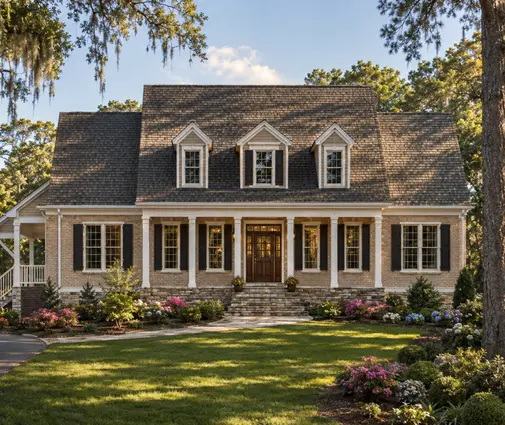
- Cathedral and sloped ceilings: shallow rafter bays leave little room for R-value plus venting. A three-storey design like this four-bedroom modern farmhouse of 2649 sq ft may have sloped ceilings on the top floor, and foam often solves them cleanly. Browse plans with vaulted ceilings with this in mind.
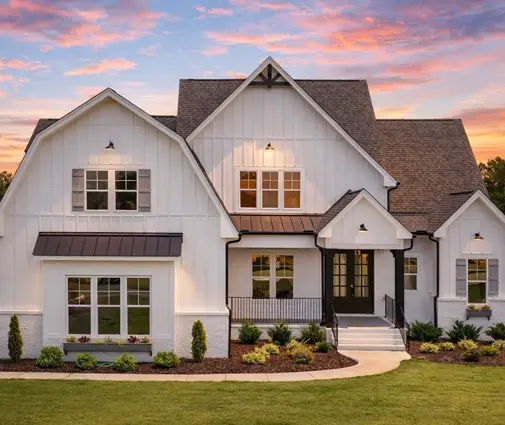
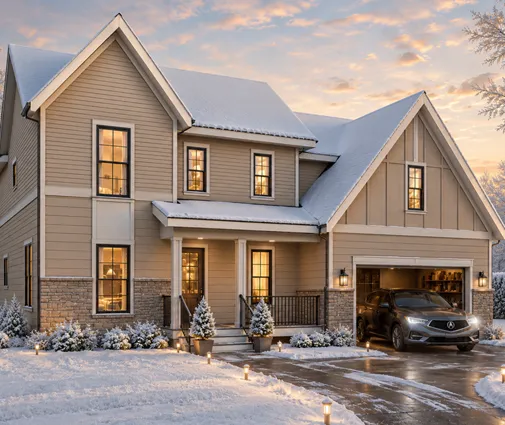
- Cantilevers and floors over garages: overhanging floors are cold, drafty and exposed. Many of the bump-outs on a contemporary multi-level home such as this four-bedroom, 3275 sq ft modern design are prime candidates.
A common middle path is "flash and batt": an inch or two of closed-cell foam to seal the cavity, topped up with a batt. It costs less than full foam and gets most of the airtightness benefit.
6. Rigid foam outside the walls and in the basement
Continuous exterior insulation (EPS, XPS, polyiso or mineral wool boards) under the cladding breaks the thermal bridging through studs, which batts can't do. One to two inches add roughly R-4 to R-10 and cost about $1.50 to $3.50 per square foot of wall installed, plus extra time for window and door bucks, longer fasteners and furring. Under the higher tiers of the BC Energy Step Code, and in some compliance paths elsewhere, it is often the most practical way to hit the target.
Below grade, full basements get insulated with rigid foam against the concrete followed by a framed wall with batts, or with insulated concrete forms (ICF) poured in place. Budget roughly $2.50 to $4.50 per square foot of basement wall for a framed and insulated R-20-range assembly, plus 2 inches of rigid foam under the slab if your code path or radiant floor calls for it. In a large basement home like this four-bedroom, 4539 sq ft two-storey farmhouse with a basement, the lower level alone can be a third of the whole insulation budget. More options are in our basement house plans.

7. Airtightness tests and the insulation inspection
In most municipalities the inspector checks insulation and vapour barrier before drywall, so schedule it and don't board up early. With batts, they look for full cavities, sealed poly laps and boxes, and the correct R-value printed on the product. With spray foam, expect to show the depth and keep the installer's documentation. Blown attics are often checked with depth markers.
A blower-door test, increasingly required under step codes and needed for most energy-efficiency rebates, measures air leakage. A test typically costs $400 to $900. Spray foam helps seal the areas that usually leak (rim joists, attic floor, cantilevers), but a house with careful batts, a well-taped poly and sealed penetrations can test just as well. Airtightness comes mostly from the air barrier details, not from the choice of insulation. Many builders run a mid-construction test before drywall so they can still fix leaks cheaply.
8. A sample insulation budget for a two-storey house
Take a typical 2,400 sq ft two-storey home with a full basement: roughly 2,600 sq ft of above-grade wall, a 1,200 sq ft attic, about 1,100 sq ft of basement wall and some 320 linear feet of rim joists. A plan in the spirit of this 4-bedroom, 3251 sq ft Craftsman two-storey would scale these numbers up by about a third. A 2025–2026 estimate with a sensible mix:
- R-22 batts and poly in above-grade walls: $2,900 to $4,400
- Blown-in R-60 in the attic: $1,600 to $2,900
- Closed-cell foam at rim joists: $1,600 to $2,900
- Basement walls in the R-20 range: $2,750 to $4,950
- Sound batts, sealing, extra air-barrier work: $1,500 to $3,000
- Blower-door testing: $400 to $900
That totals about $11,000 to $19,000. Adding an inch or two of exterior rigid foam brings it to roughly $15,000 to $27,000, and full closed-cell foam in all walls instead of batts adds another $6,000 to $10,000 on top.
The simple rule for a new Canadian house: use batts in straight 2x6 walls, blow the attic, spend on closed-cell foam only where the framing makes batts fail, and add exterior insulation when your code path or energy target calls for it. Before you sign, ask each contractor to price the same R-values area by area, so you are comparing assemblies, not brochures.