It is 6 a.m. in late January, the thermometer on the deck reads -31°C, and somewhere in the basement a small controller is deciding which fuel will warm the house. That decision, made hundreds of times a winter, is the whole idea of dual-fuel heating. An air-source heat pump carries the load through the mild and moderately cold days, and a natural gas or propane furnace takes over when outdoor air gets too cold for the compressor to work cheaply or keep up at all.
For many Canadians building a new house, the hybrid is a hedge: it buys most of the efficiency of electric heating without betting the coldest week of the year on it. But the system only pays off if it is designed around your house, your utility rates and your municipality's rules. The steps below follow the order in which a designer, an HVAC contractor and you should actually make these choices.
Step 1: Get a room-by-room heat loss calculation
Everything else depends on one number: how many BTU per hour the house loses at your local design temperature. In Canada this is done to the CSA F280 standard, and most building departments now want to see it with the permit drawings. Ask for it on the finished plans, with your actual wall assemblies, window specs and air-tightness target, not on a rule of thumb per square foot.
A well-insulated new home often needs far less heat than people expect. A compact bungalow with a full basement, such as this four-bedroom single-level Craftsman, may come in around 25,000 to 35,000 BTU/h at -25°C design conditions, which a single cold-climate heat pump can nearly cover alone.
Time: one to two weeks. Cost (2025): roughly $300 to $1,000, sometimes bundled into the HVAC design fee.
Step 2: Confirm what your municipality and province will allow
Before you fall in love with a gas backup, check whether you can have one. Rules are moving in different directions across the country. Some British Columbia municipalities have adopted the province's carbon-related tiers for new construction, which can make a fossil-fuel furnace in a new detached house difficult or impossible. Quebec's approach, by contrast, has actively encouraged electric heat pumps paired with a fuel backup for peak hours. In much of Ontario, the Prairies and Atlantic Canada, gas backup remains permitted under the building code, but the energy compliance path you choose may need extra insulation or airtightness to offset it.
On a rural acreage there may be no gas main at all, so the backup becomes propane, with a tank, a delivery contract and a different price per unit of heat.
Time: a call or two to the building department, plus a check with your gas utility about service availability. Cost: nothing yet, but ask the utility about connection fees, which in 2025 commonly ran from a few hundred to several thousand dollars depending on distance from the main.
Step 3: Compare your fuel prices and find the economic switchover
This is where the province you live in matters most. The comparison is simple once you put both fuels in the same unit, the cost of one kilowatt-hour of delivered heat:
- Gas: one cubic metre of natural gas holds about 10.3 kWh of energy. A 96% furnace delivers close to 10 kWh of heat from it. At an all-in price of $0.50 per cubic metre, heat costs about 5 cents per kWh.
- Heat pump: divide your all-in electricity price by the unit's coefficient of performance (COP) at that outdoor temperature. At 15 cents per kWh and a COP of 2.5, heat costs 6 cents.
The economic switchover is the outdoor temperature at which the two numbers meet. The table shows how different rate patterns move it, using illustrative 2025 price ranges; plug in your own bills before relying on it.
| Rate situation | Electricity (all-in) | Gas heat cost | COP needed to beat gas | Typical economic switchover |
|---|---|---|---|---|
| Low-cost hydro power | 7–9 ¢/kWh | 6–8 ¢/kWh | about 1.1–1.4 | very low, often below -20°C |
| Mid-range power, mid-range gas | 13–17 ¢/kWh | 4.5–6 ¢/kWh | about 2.5–3.2 | roughly -5°C to -12°C |
| Expensive power, cheap gas | 17–22 ¢/kWh | 3.5–5 ¢/kWh | about 3.5–5 | near 0°C or above |
| Propane backup | 13–17 ¢/kWh | 9–14 ¢/kWh | about 1.2–1.8 | usually below -15°C |
Two things often shift the result. Time-of-use pricing can make the heat pump cheap overnight and costly at the evening peak, and gas bills carry a fixed monthly charge you pay whether the furnace runs or not. Count that charge, often $20 to $35 a month in 2025, as part of the cost of keeping gas at all.
Time: an evening with a year of utility bills or published rate sheets.
Step 4: Find the capacity balance point too
The cheapest switchover is not the only limit. Every heat pump also has a capacity balance point: the temperature below which it can no longer supply the house's full heat loss. Ask your contractor to plot the unit's output at -15°C, -20°C and -25°C against the load line from Step 1. The furnace must take over at whichever point comes first, cost or capacity.
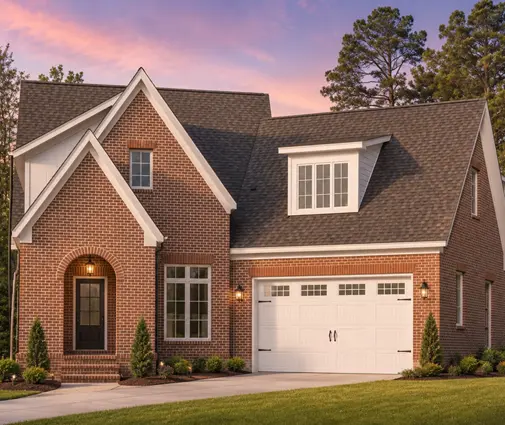
For a two-storey house with a lot of glass, like this Tudor-style family home with its steep gables and four bedrooms, the capacity limit will likely arrive sooner than for a tight one-level plan, and a single outdoor unit may be stretched.


Step 5: Choose matched equipment and a real dual-fuel control
A hybrid system is usually three pieces: a cold-climate outdoor unit, an indoor coil mounted on top of the furnace, and a condensing furnace with a variable-speed blower. In most installations the heat pump and furnace do not run at the same time, because hot furnace air passing over the coil can push refrigerant pressures too high. The controller handles the handoff.
- Pick an outdoor unit rated for cold-climate use, with published capacity at -25°C or lower.
- Size the furnace for the full design load, since on the coldest nights it works alone. A modulating furnace avoids short cycling in a tight house.
- Use a thermostat or control board with an outdoor sensor, so you can set a lockout temperature instead of relying on the heat pump to call for help after the house has already cooled.
- Plan for an HRV or ERV. New homes in most provinces need mechanical ventilation, and it can share the ductwork.
Cost (2025, new build, installed): a dual-fuel package typically ran about $14,000 to $24,000 including ducts, against $12,000 to $22,000 for an all-electric cold-climate heat pump with electric resistance backup. The electric option may need a 200-amp service, while the hybrid adds the gas line, venting and the connection fee from Step 2. The real difference is often less in the hardware than in what each one costs to run in your province.
Step 6: Shape the house plan around the mechanical system
Good hybrid systems start on the floor plan. A full basement gives you a central mechanical room with short, straight trunk lines, a spot for the HRV, and space to keep ducts inside the heated envelope. That is one reason so many plans in the basement collection suit this kind of equipment.
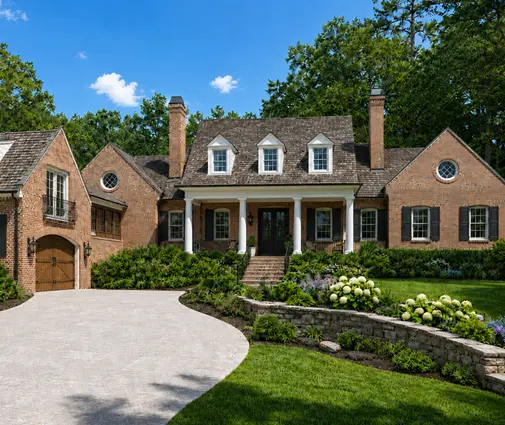
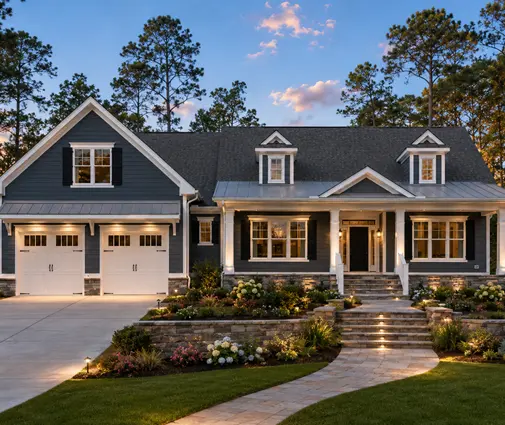
A five-bedroom bungalow like this compact Craftsman with a lower level keeps every supply run short, while a European-styled single-storey plan of similar size shows how a simple rectangle eases duct layout. If you prefer bedrooms upstairs, the two-storey designs need a return on each floor and, in larger homes, two zones or two systems. A very large house, such as this Acadian-inspired estate over a full basement, almost always benefits from splitting the load between two heat pumps so each runs closer to its sweet spot.
Also leave a clear path outdoors for the refrigerant lines, a level pad for the outdoor unit raised above the drift line, and a spot sheltered from roof runoff, so ice does not build on the coil.
Step 7: Line up permits and any available incentives
Heat pump installation usually needs an electrical permit, and the gas side needs a gas permit and inspection by a licensed fitter. Your HVAC designer's drawings and the F280 report go with the building permit.
Incentives change often and many are aimed at existing homes switching from oil or electric baseboard, not at new construction. Some utility and provincial programs have paid for hybrid systems specifically; others reward only all-electric heating, and some offer builder rebates for homes that beat the code's energy target. Check the current program terms with your utility and province before you sign the contract, and do not count a rebate in your budget until it is confirmed in writing.
Time: permits run in parallel with the building permit, typically two to eight weeks depending on the municipality.
Step 8: Commission the system and tune the switchover each winter
At startup, have the installer verify refrigerant charge, airflow and the lockout settings, and leave you a written record of the switchover temperature and why it was chosen. Then watch the first winter. If bills show the furnace running on days when the heat pump would have been cheaper, lower the lockout a few degrees; if the house feels cool during cold snaps, raise it.
Revisit the setting whenever your rates change. A jump in gas delivery charges or a new time-of-use plan can move the best balance point by several degrees.
Cost: commissioning is usually included; a yearly service visit cost roughly $150 to $300 in 2025.
Timeline at a glance
| Stage | When | Duration | Rough cost (2025) |
|---|---|---|---|
| Heat loss calculation | Final design drawings | 1–2 weeks | $300–$1,000 |
| Code and utility check | Before permit application | 1–2 weeks | Connection fee varies |
| Rate comparison and switchover | Design stage | 1 evening | None |
| Capacity check and equipment choice | Design stage | 1–3 weeks | Included in quote |
| Permits | With building permit | 2–8 weeks | Municipal fees |
| Rough-in of ducts, gas and lines | After framing | 1–2 weeks | Part of $14,000–$24,000 |
| Commissioning | Before occupancy | 1 day | Usually included |
| First-winter tuning | First heating season | Ongoing | None |