The driller sets up on a Monday, quotes you by the foot, and says he will "know more at 150". By Wednesday he is at 340 feet in Shield granite and still getting barely two gallons a minute. Nobody can give you a fixed price for a well before it is drilled, and that is why it is so often the line in a rural build budget that runs over. You can still plan for it. This guide sets out what a well for a new house costs in Canada in 2025, what comes on top of the hole itself, what happens when the water is scarce or poor, and where the well belongs on your site plan.
What a drilled well costs per foot in 2025
Most drillers price two things separately: drilling per foot, and steel casing per foot. Casing is the 6-inch steel pipe that runs through the soil and gravel (the overburden) and is sealed into solid bedrock so surface water cannot run down the outside of it. On a lot with 15 feet of overburden you pay for little casing. On a lot with 120 feet of clay and sand above the rock, casing can cost more than the drilling.
Typical ranges by region
The figures below are rough ranges from contractor pricing in 2025 for a 6-inch domestic well. They are not tariffs. Prices move with fuel costs, how busy local rigs are and how far the rig has to travel, so get at least two or three written quotes.
| Region | Drilling (per ft) | Typical depth | What to expect |
|---|---|---|---|
| Southern Ontario, St. Lawrence lowlands (limestone, sandstone) | $30 to $50 | 80 to 250 ft | Usually reliable yield. Hard water is common. |
| Canadian Shield (cottage country, Northern Ontario, Laurentians, Outaouais) | $35 to $60 | 150 to 500 ft | Water sits in fractures, so yield is unpredictable. Iron and sometimes arsenic or uranium. |
| Prairies (Alberta, Saskatchewan, Manitoba) | $35 to $70 | 100 to 400+ ft | Deep sand and gravel or bedrock aquifers. Hardness, sulphate, sodium, iron and manganese. |
| BC Interior and Vancouver Island | $40 to $80 | 100 to 600 ft | Wide variation from one valley to the next. Arsenic in some areas. |
| Atlantic provinces | $30 to $55 | 100 to 400 ft | Fractured bedrock. Arsenic and manganese in parts of Nova Scotia and New Brunswick. |
Installed steel casing usually adds $25 to $45 per foot. As a result, a finished drilled well with no pump typically costs $8,000 to $25,000. Deep holes in the Shield or the BC Interior can go well beyond that.
Dug wells vs drilled wells
A dug or bored well is a wide shaft, usually lined with 3-foot concrete crocks, and is typically 20 to 50 feet deep. It draws on shallow groundwater, so it costs less to build, often $5,000 to $15,000. The drawbacks are serious for a new family home:
- Drought. Shallow water tables drop in late summer, and dug wells are the first to run low.
- Contamination. Surface water, manure and septic effluent reach shallow water much more easily, and bacteria problems are common.
- Financing. Some lenders and insurers are more cautious with dug wells, so ask before you commit.
Drilled wells cost more up front, but they draw from deeper, better-protected water, and they are what most builders and lenders now expect on a new rural home. A dug well still makes sense in a few places with a high, clean water table and shallow bedrock that is hard to drill into. Your local driller will know whether your area is one of them.
Beyond the hole: pump, tank, trench and connection
The well is only the start. To get water to a kitchen tap, budget for the following items (2025 ranges, installed):
- Submersible pump, 1/2 to 1 hp, with wire, drop pipe, pitless adapter and well cap: $2,000 to $5,000. Deep wells need more horsepower and more pipe.
- Pressure tank and controls: $600 to $2,000. A constant-pressure (variable-speed) system costs more but gives steady pressure with several showers running at once.
- Trench and water line to the house: $25 to $60 per foot. The line has to sit below frost depth, which means roughly 5 to 8 feet in most of the country and deeper in the north. Rock under the lot can multiply this cost.
- Electrical: a dedicated circuit and, often, a disconnect at the well. Allow $500 to $1,500 depending on distance.
- Disinfection, flow test and water test: a few hundred dollars. Some drillers include them.
All in, a complete water supply on a rural lot usually lands between $15,000 and $40,000 in 2025. A sensible contingency is to plan for the higher end of your region's range and treat anything less as a saving.
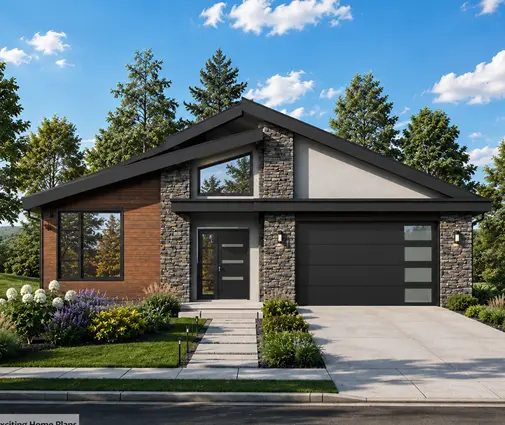
The house itself shapes this budget too. A 1.5-bathroom bungalow puts much less peak demand on a well than a home where four showers can run at once. Modest plans such as this 1,899 sq ft one-storey Craftsman with a basement or a 1,758 sq ft bungalow with five bedrooms and a full basement are forgiving on a well with modest yield. The basement is also the natural place for the pressure tank and treatment equipment.


When the drill comes up dry or the flow is low
Drillers are paid for the footage they drill, whether or not they find water. That is the risk you carry, and it is worth discussing before the rig arrives:
- Agree on a stopping point. Decide in writing at what depth the driller should stop and call you rather than keep going.
- Ask about dry-hole terms. Some contractors reduce the rate on a dry hole or on a second attempt. Others do not. Find out which you are dealing with.
- Consider hydrofracturing. Pumping water at high pressure into a low-yield bedrock well can open fractures and raise the yield. It often costs $3,000 to $7,000 and works better in some rock than in others.
- Add storage. A slow well that delivers steadily over 24 hours can still supply a family if you add a storage tank (often 300 to 1,000 gallons) and a second booster pump. This is common in the Shield and on the Prairies.
- Use a cistern as a last resort. Some Prairie and island properties rely on hauled water or rainwater, but check whether your municipality and lender will accept that.
Before buying an acreage, look up the well records for neighbouring properties. They are the best preview of depth and yield you will get.
Well records, flow tests and what lenders ask for
Provincial well records
Most provinces require the licensed driller to file a well record with depth, casing, geology, static water level and a yield estimate. Ontario, Alberta, Saskatchewan, Manitoba, BC, Quebec and the Atlantic provinces all keep searchable well databases or maps. Ask your driller for a copy of your own record and keep it with the house documents, because you will need it if you ever sell.
Quantity and quality tests
Lenders financing a rural build, and buyers later on, typically want two things:
- A potability test for bacteria (total coliforms and E. coli). Many provinces offer free or low-cost bacteria testing through public health labs. A wider chemical panel from an accredited lab usually costs $150 to $400.
- A flow or yield test, a pumping test over several hours showing the well can sustain a household's demand. The required rate and duration vary by lender and municipality, so ask your lender for their exact requirement before the driller leaves the site. It is much cheaper to run the test while the equipment is still there.
Some municipalities also require a hydrogeological study before they will issue a building permit for a new lot, especially for severances and rural subdivisions. Check this with the planning department early, because it can take weeks.
Water treatment: hardness, iron, sulphur and arsenic
Do not buy any treatment equipment until you have a lab analysis in hand. Then match the equipment to the actual problem:
| Problem | Signs | Common fix | Installed cost (2025) |
|---|---|---|---|
| Hardness | Scale on fixtures, poor lather | Water softener | $1,500 to $4,000 |
| Iron and manganese | Orange or black stains | Oxidizing filter, often ahead of the softener | $2,000 to $5,000 |
| Hydrogen sulphide | Rotten-egg smell | Aeration, chlorination or oxidizing filter | $2,000 to $6,000 |
| Bacteria | Positive lab test | Shock chlorination, then a UV system | $1,200 to $3,000 |
| Arsenic, uranium | No taste or smell; lab test only | Reverse osmosis at the kitchen tap, or a whole-house system | $800 to $2,500 at the tap; much more for whole-house |
Treatment equipment needs a drain, a power outlet, frost-free space and room to change filters. A basement mechanical room handles all of that easily, which is one more reason basements are standard in rural Canada. If you are choosing between plans, a layout from the house plans with a basement collection leaves room for the pressure tank, softener, UV unit and an HRV without taking space from the main floor. On a slab-on-grade plan, set aside a heated utility room of at least 60 to 80 sq ft.
Where the well goes on the site plan
On a rural lot, the well, the septic system and the house have to be placed together. Do not leave the well to the driller's convenience on the day the rig arrives. The general rules are:
- Keep the well away from the septic field. Building codes and provincial well regulations set minimum distances between a well and the septic tank and leaching bed. Under Ontario's building code, the distance depends on whether the well has watertight casing to a minimum depth, and 15 to 30 metres is the range people usually work with. Other provinces have their own tables, so confirm the numbers with your municipality or septic designer.
- Place the well upslope of the septic system and any livestock area, so that surface flow and shallow groundwater move away from it.
- Keep a clear distance from the house so a rig can return later for service or deepening. Do not put the well under a deck, a driveway or a future addition.
- Keep the trench short and straight where possible. Every foot of frost-depth trench costs money, and running it in rock costs much more.
- Look beyond your own lot. Setbacks apply to your neighbours' septic systems and wells too.
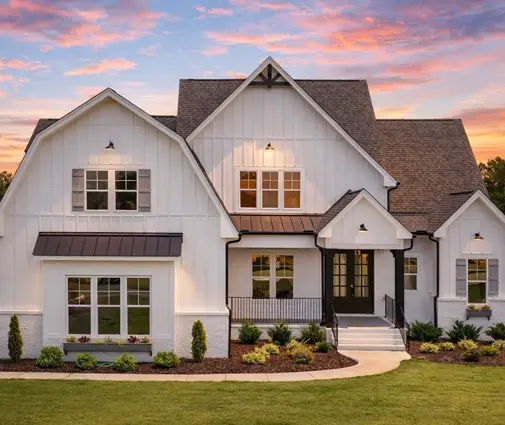
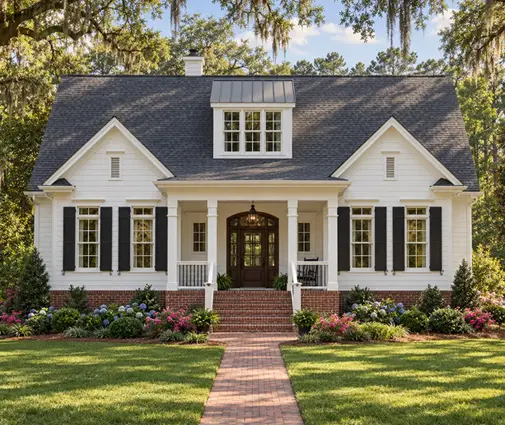
A long single-storey house takes up more of the lot and can make these distances harder to fit on a narrow acreage. A 2,742 sq ft one-storey modern farmhouse with four bedrooms needs more room than a two-storey home with a similar area. The 3,912 sq ft two-storey farmhouse with five bedrooms uses a smaller footprint. With 4.5 bathrooms, though, it is the kind of house where a constant-pressure pump and a storage tank are worth considering. At the large end, a 4,539 sq ft two-storey with a basement and 5.5 bathrooms calls for a well with solid, tested yield. Browse more farmhouse house plans with the site plan open beside you.

FAQ
How deep will my well be?
The best guide is the well records for nearby properties in your province's database. Across Canada, most domestic drilled wells are somewhere between 80 and 400 feet deep, and Shield and mountain areas are often deeper.
Should I drill the well before buying the lot?
If you can negotiate it, yes. Making the purchase conditional on a successful well, or at least on a review of neighbouring well records, removes the biggest unknown from a rural build.
Is a geothermal heat pump loop the same as a water well?
No. Closed-loop geothermal boreholes do not supply drinking water and have their own drilling quotes and setbacks. Some provinces regulate them under the same well rules, so ask your driller.
How often should a private well be tested?
Public health agencies commonly recommend a bacteria test at least once or twice a year, and after floods or any change in taste or colour. A full chemical panel every few years is a sensible habit.