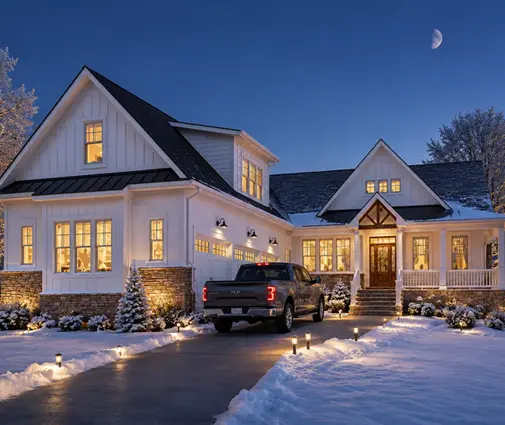
The listing says "hydro at the road." The lot is 20 acres of mixed bush with a clearing 1,500 feet back, exactly where you picture the house. Then the utility's estimate arrives, and the number has more digits than you expected. This happens to acreage buyers across Canada every year. Electricity at the lot line and electricity at your panel are two very different things, and the gap between them can cost as much as a good used truck, or as much as the basement.
Below are the nine things that set that cost, roughly in the order you will meet them. The figures are typical 2025–2026 ranges in CAD. Rates, allowances and rules change often and differ by province and utility, so always get a written quote for your own lot.
1. The quote comes from the utility, and you should get it before you buy
Hydro One, BC Hydro, FortisAlberta, SaskPower, Hydro-Québec and the other utilities each have their own process for a new rural connection. It usually looks like this: you apply with the lot address and a site plan, a designer or field representative visits, and you receive a preliminary estimate. After that you pay a deposit or the full contribution before the work is scheduled. Some utilities credit an allowance against the cost of a new residential connection. Others pass most of the extension cost to the customer. How the allowance is calculated varies, so ask how it applies to your lot.
If you can, make your offer conditional on a preliminary estimate, or at least call the utility during your due diligence. A free phone conversation about the nearest three-phase or single-phase line, and whether it has capacity, can save you from a five-figure surprise.
2. The setback from the road multiplies everything
Almost every cost below grows with distance. On a typical suburban-style rural lot with the house 100 to 200 feet from the road, the connection is usually a service drop or a short underground run. In 2025 that often lands between $3,000 and $15,000 all in. Push the house back 1,000 feet and you are now paying for a line extension: poles or a long trench, possibly a transformer of your own, tree clearing and design fees. Totals of $25,000 to $60,000 are common, and remote sites can exceed $100,000.
That clearing at the back of the lot may have the best view. Still, price two locations before you settle the house on your site plan. A compact bungalow like this 1,577 sq ft three-bedroom modern ranch with a basement fits comfortably closer to the road on most acreages, and the savings on hydro and the driveway can pay for a lot of finishing.
3. Overhead lines: cheaper per foot, but the poles add up
Overhead is usually the least expensive way to cover long distances. Spans between poles commonly run 100 to 150 feet, depending on terrain, voltage and the utility's standards. Each pole with anchors, hardware and installation can cost several thousand dollars. On a long lane, overhead line work often prices out somewhere in the range of $30 to $80 per foot in 2025, before clearing.
The hidden costs are around the poles. Utilities need a cleared right-of-way and road access for their trucks. They also usually need an easement registered on title so they can maintain the line. Tree clearing on a wooded lot can be a significant extra line item. Rock may also call for special anchoring. Some utilities let you hire an approved contractor for parts of the work. Others do everything in-house.
4. Underground service: tidier, pricier, and dependent on your soil
Burying the service looks better, keeps the lane clear of poles and is far less exposed to ice storms and falling trees. The price depends heavily on what is under the topsoil. In clay or sandy loam, trenching and laying conduit might cost $30 to $70 per foot in 2025. On the Canadian Shield or in boulder till, rock breaking can double or triple that, and sometimes rules out a long buried run altogether.
Depth requirements for direct-buried cable and conduit follow the electrical code and utility standards, and frost and loading conditions play into them. Your electrician or the utility will confirm the specifics. A common money saver is to open one trench for hydro, the water line from the well and a conduit for internet, coordinated with your contractor and the utility's separation requirements. Many owners also run overhead primary to a pole near the yard and go underground only for the last stretch to the house.


5. The transformer may be yours to pay for
When the house is close to an existing transformer, you share it with your neighbours and never see it on the bill. When the house is far from the line, the utility has to extend primary voltage toward you and step it down near the house. That means a transformer dedicated to your service. A pole-mount unit is generally the cheaper option. A pad-mount transformer, needed for an underground primary, costs more and needs a concrete pad and clearances around it.
Depending on the utility, the transformer may be included in the extension price, partly covered by an allowance, or itemized separately. In 2025 the installed cost of a residential transformer typically adds several thousand to well over $10,000. Ask the utility to break it out so you can compare options.
6. The meter base, service entrance and panel are on your side
The utility usually stops at the meter, sometimes at a demarcation pole. From there your licensed electrician installs the meter base, the service mast or underground entry and the main panel. They pull the electrical permit and book the inspection, through the Electrical Safety Authority in Ontario or your provincial or municipal inspection authority elsewhere. For a 200-amp service in a new house, the service entrance and panel typically run $2,500 to $6,000 in 2025. That figure excludes the wiring of the house itself.
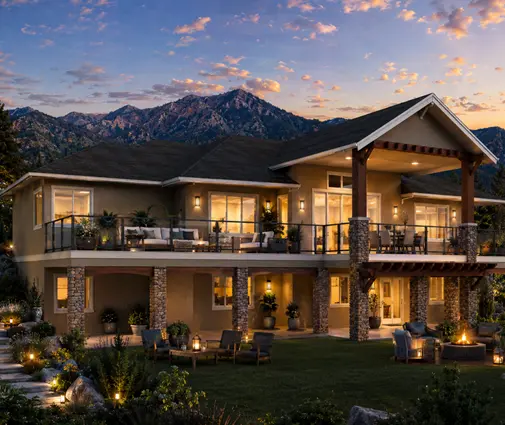
Decide early where the service enters. A mechanical room in the basement, on the wall facing the road, keeps the run short. Plans with a full basement, such as this 1,899 sq ft Craftsman bungalow with three bedrooms, give you room for the panel, an HRV, a water treatment system and a battery bank if you add one later. Browse more house plans with a basement if that layout suits your lot.
7. Lead times can be longer than your framing schedule
Rural connections are rarely quick. Between the application, design, easement paperwork, materials and crew scheduling, waits of three to nine months were common in 2025. Longer waits happen where transformers are back-ordered or the line needs an upgrade. Frozen ground or spring load restrictions on rural roads can push the work back further.
Apply as soon as you have a site plan and a building permit application in progress, not when the drywall is going up. Meanwhile, plan for temporary power. That could be a generator on site or, if the utility allows it near the road, a temporary service pole. Budget for fuel or rental, which can quietly add a few thousand dollars over a build.
8. Size the service to the house you will actually live in
A cold-climate heat pump, an electric water heater, an induction range, an EV charger and a heated shop can push a home past what a 200-amp service handles comfortably. Upgrading to 400 amps later can mean a new transformer, new conductors and a new panel. Doing it at the original connection costs much less. Ask your electrician for a load calculation based on the actual plan before you apply for the connection.
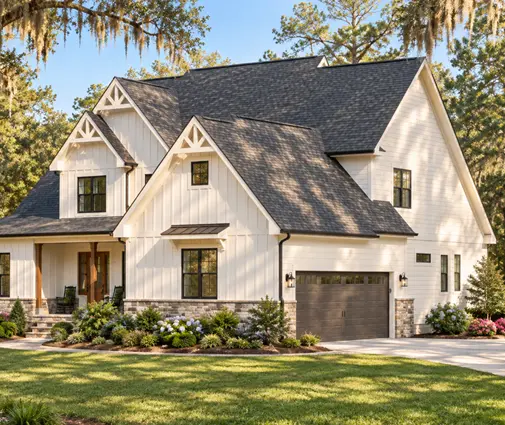
Larger homes make this decision for you. A four-bedroom farmhouse like this two-storey 3,062 sq ft modern farmhouse, or this 3,744 sq ft farmhouse with four bedrooms, will often justify the bigger service from day one, especially with all-electric heating. Our farmhouse house plans are popular on acreages for exactly this kind of lot.


9. When an off-grid solar quote is worth getting
If the extension estimate is very high, price an off-grid system in parallel. A system that can carry a Canadian family through December needs a solar array, a substantial battery bank, an inverter and a backup generator, because winter sun is weak and snow covers panels. In 2025 a full year-round off-grid setup for a modest home commonly ran $50,000 to $120,000 or more. Batteries will need replacing over the life of the house, and your heating must be designed around limited winter power. That means good wood heat, propane or a very efficient envelope rather than an all-electric heat pump setup.
Off-grid tends to make sense when the extension quote is in the high five or six figures, when the lot is a seasonal cottage, or when the house is small and highly efficient. A one-storey home with a simple footprint is the easiest to power this way. Think of this 2,308 sq ft four-bedroom ranch with a basement, or the wider range of one-storey house plans. For a large family home with an attached garage and a workshop, the grid usually still wins over 25 years. Check also whether your insurer and lender have conditions for off-grid homes.
The short version
Hydro at the road is a starting point, not a promise. Get the utility's estimate early. Compare at least two house locations on the lot. Ask for overhead and underground options, a transformer breakdown and a realistic timeline. Size the service to the plan you will actually build. And if the number keeps climbing, put an off-grid quote beside it before you decide. The house should sit where it works best for your family, but knowing what each choice costs makes that decision much easier.