Picture the listing: a treed acre, a dock, a sunset over the bay. Now picture the call from the township a month after you close, telling you the spot where you planned the house sits inside a regulated area and the septic bed cannot go where the seller said it could. That call is common, and most of it can be avoided before the offer is signed.
Canadians are not alone here. Families in the United States, Germany and Poland chase the same kind of site, and each country has built its own fence around it. Looking at how they do it shows which of our rules are unusual, which are universal, and where a Canadian buyer should dig hardest.
1. Canada hands the shoreline to more than one authority
In most provinces a waterfront permit is not just a municipal building permit. In Ontario, the local conservation authority usually has to sign off on work near lakes, rivers, valleys and wetlands, and it can refuse or reshape a project before the building department even opens the file. Quebec protects a vegetated shoreline strip, generally in the range of 10 to 15 metres, where clearing and building are tightly limited. British Columbia layers riparian rules for fish habitat on top of local bylaws. Many official plans across the country also set a water setback, often around 30 metres in cottage country, though the figure varies by municipality and by lake.
The practical lesson: before you make an offer, ask the municipality and, where one exists, the conservation authority which approvals apply to that exact parcel. A lot that looks generous on paper may have a building envelope a fraction of its size.
2. The US runs everything through the flood map
South of the border the first question is rarely about distance from the water; it is about the colour of the parcel on the federal flood maps. Land inside a high-risk zone triggers mandatory flood insurance for most mortgages and requires the lowest floor to sit above a set flood elevation, which is why so many American lake and river homes stand on piers or raised crawlspaces. Shoreline setbacks exist too, but they come from states and counties and vary widely.
For a Canadian, the takeaway is that flood mapping here is patchier and often older. Do not assume a lot is safe because no map flags it. Ask for any local floodplain study, look for high-water marks on trees and sheds next door, and talk to neighbours who have been there through a spring melt.
3. Germany starts from "no" outside the village
German planning law splits land into areas covered by a development plan and everything else, the so-called Außenbereich. Out there, an ordinary family home is generally not permitted at all; only certain uses such as farming or forestry get through. A pretty meadow by a river with no plan behind it is, for most Germans, simply not a building lot. Designated flood areas carry their own near-ban on new homes.
Canada is far more permissive about rural houses, which is a real advantage. But the German logic is worth borrowing: confirm the zoning permits a dwelling, that the lot was legally created, and that it is not inside a hazard overlay, before you fall for the view.
4. Poland measures the distance to the trees
In Poland a forest edge is treated as a fire hazard, so national rules require a minimum gap between a house and the woods, and building close to lakes or rivers usually calls for a separate water-law permit. Much of the country's most scenic land also falls within Natura 2000, the EU network of protected habitats, which adds an environmental review to the process.
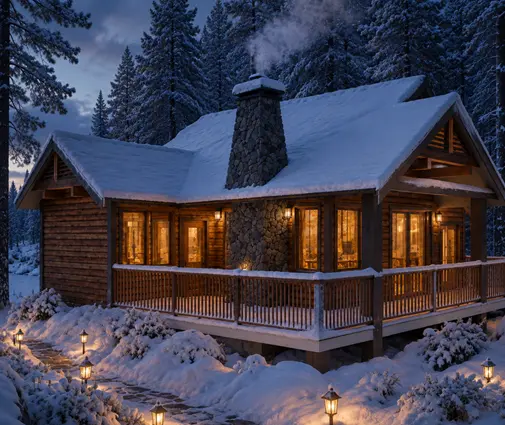
Canada has no single national forest setback, yet wildfire is now the bigger threat on many wooded lots, especially in BC, Alberta and northern Ontario. Some municipalities have adopted FireSmart-style guidance, and insurers increasingly ask about it. A cleared zone around the house, non-combustible roofing and siding near grade, and ember-resistant vents cost little at the design stage. For a compact woodland retreat, the 975 sq ft Scandinavian cabin keeps a simple footprint that is easy to ring with a defensible clearing.
5. High groundwater makes the basement a gamble
This is where the Canadian habit hurts. A full basement is our default answer to frost, but on low ground beside a lake or river the water table may sit a metre or two below grade for half the year. A basement there means a sump pump that never rests, a backup generator, and a real chance of seepage in April. Germans and Poles on similar soil often choose a slab or a raised floor instead, and Americans in flood zones rarely dig at all.
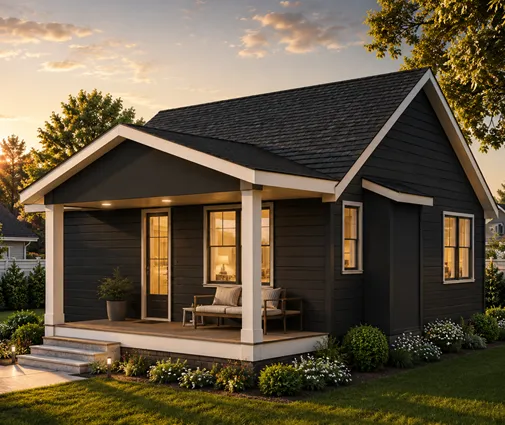
Frost does not force a basement on you. A frost-protected shallow foundation with insulated skirts, or a heated crawlspace raised above the wet season, can carry a fully winterized home. Plans drawn without a lower level suit this approach well: the two-bedroom lake cabin with a deep front porch sits comfortably on a raised foundation, and the 750 sq ft cottage needs very little excavation at all. Order a geotechnical report and a test pit in spring, not August, when the ground lies to you.
6. Insurance and the road decide whether you can live there
Overland flood coverage in Canada is still an optional add-on, and on some waterfront properties it is expensive or hard to get. Ask a broker for a quote on the specific address before you waive conditions, and do the same for wildfire risk on forested acreages. Lenders may also hesitate if the home cannot be insured properly.
Access is the other quiet deal-breaker. Many lake lots sit on private or seasonal roads that no one plows, or that the municipality has never assumed. That can block a building permit, leave emergency vehicles unable to reach you, and make a year-round mortgage harder. In the US and much of Europe, legal access to a public road is a basic condition for building; treat it the same way here, and get a road maintenance agreement in writing if the road is shared.
7. Turn the house toward the view, not the driveway
Every country on this list ends up with the same smart layout. The car arrives on the road side, where the garage, mudroom and entry absorb snow, boots and noise. The living space, kitchen and main bedroom open the other way, onto a deck or terrace facing the water or the woods. Plans with large windows across the back make the most of this, especially if that side faces south.
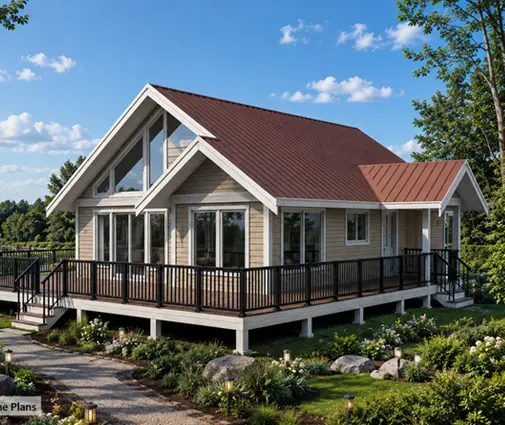
The chalet-style bungalow with a broad gable is a good template for a lake lot where the glass wall faces the shore. If you want a garage that shields the entry, the bungalow with a double garage up front keeps vehicles toward the street and leaves the rear free for living. For a sleeker look, the modern Scandinavian plan pairs a single bay with clean lines that frame the trees. On land that drops toward the water, browse sloped lot designs so the grade works for the view instead of against the foundation.


Bringing it home
Americans fight the flood map, Germans fight the zoning line, Poles fight the forest buffer. Canadians face a bit of each, spread across municipal, provincial and conservation bodies that do not always talk to one another. Confirm the building envelope, check groundwater before you commit to a basement, price the insurance, and make sure the road is legal and plowed. Then design a home with its back to the road and its face to the water. Rules change by province and by township, so verify the current requirements with your municipality and a local designer or architect before you buy.