A new house built to today's codes can be so airtight that a wood stove struggles to draw a breath. On an acreage or at the lake, plenty of Canadians still want a real fire, and there's no reason not to have one. A stove in a tight house just has to be planned at the design stage, not added as an afterthought. These are the questions homeowners ask most often before they build.
Can you install a wood stove in a new airtight house?
Yes, but it must be a certified, low-emission appliance designed to work in a tight building envelope. An older house leaked enough air to feed a fire and replace the air that went up the chimney. A modern house built with a continuous air barrier, careful sealing and a blower-door test does not. In BC, if your municipality has adopted higher steps of the Energy Step Code, the house will be tighter still.
The fix comes down to three things. Choose an appliance that can take combustion air from outdoors. Manage the fans that pull air out of the house. And size the stove for a house that needs far less heat than an old farmhouse did.
What do CSA B415.1 and EPA certification mean?
They are the emission standards that show a wood stove burns cleanly. CSA B415.1 is the Canadian standard, and the U.S. EPA certification is widely accepted alongside it. Certified stoves use secondary combustion, either catalytic or non-catalytic, to burn the smoke before it leaves the firebox. Compared with an uncertified unit, they produce far less particulate and creosote and burn noticeably less wood for the same heat.
Look for the certification label on the appliance and keep the documentation. Many municipalities, insurers and some rebate programs ask for it. Installation itself is governed by CSA B365, the manufacturer's listing and your provincial building code.
Do I need an outdoor combustion air supply?
In a tight new home, you almost always should have one, and many appliances and local codes expect it. An outdoor air kit runs a duct from outside directly to the stove's air intake. The fire then burns outdoor air instead of competing with the house for it.
Plan the duct route on the drawings: through the rim joist, through the slab, or through a crawlspace. The intake should sit where snow won't bury it and away from the gas meter and dryer vent. A fully sealed, direct-vent stove gives the best protection, though not every wood appliance is available in that configuration.
Will my HRV, range hood or dryer cause backdrafting?
The HRV usually won't, but the range hood, clothes dryer and central vacuum can. A properly balanced HRV supplies as much air as it exhausts, so it doesn't pull the house negative.
A powerful range hood is a different story. Many hoods in open-concept kitchens move several hundred cubic feet per minute. Running one in a tight house can reverse the draft in the chimney and pull smoke and carbon monoxide into the living room.
Ask your designer or HVAC contractor about make-up air for the range hood. Several jurisdictions require it above a certain fan capacity, so check locally. Have the HRV balanced at commissioning. Install carbon monoxide alarms as your provincial code requires in any home with a fuel-burning appliance. If you love cooking on high heat, a moderate hood with good capture may be wiser than a huge one.
How far must the stove and chimney be from combustible materials?
The clearances printed on the stove's listing label are the legal minimum, and they differ from model to model. Rear and side clearances to drywall over wood studs can often be reduced with approved heat shields. The non-combustible hearth pad must extend beyond the door and sides by the distances the listing specifies.
For the chimney, the familiar rule in Canadian codes is the 3-2-10 rule. The chimney must rise at least 3 ft above where it exits the roof, and at least 2 ft higher than anything within 10 ft horizontally. In heavy-snow regions, also plan for the snow load, a chimney cricket and the bracing.
Run the insulated factory-built chimney up through the warm interior of the house rather than in an exterior chase. A warm chimney drafts better and builds up less creosote.
Where should the stove go in the floor plan so the heat reaches the bedrooms?
Put it centrally, on the main floor, in or next to the largest open space, with the bedrooms a short and open path away. A stove tucked in the corner of a great room at one end of the house will roast that room and leave the far bedrooms cold.
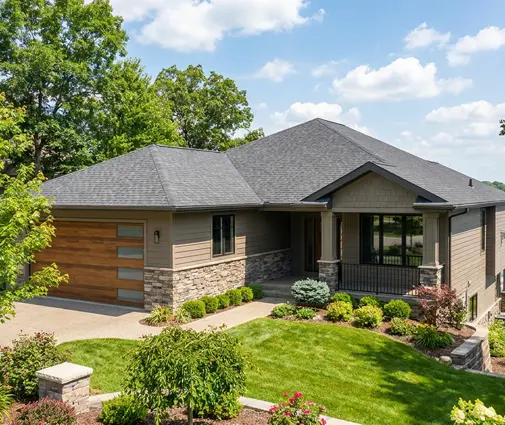
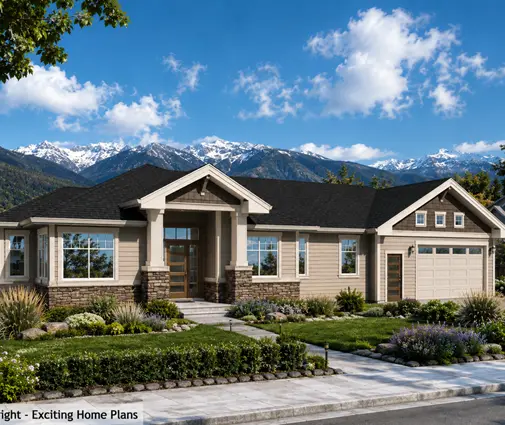
A compact bungalow works well. In a layout like this 1,603 sq ft modern mountain one-storey with three bedrooms and a basement, a stove near the centre of the living area sits only a few steps from the bedroom hallway. The vaulted, rustic 1,577 sq ft Northwest-style bungalow with three bedrooms works the same way.
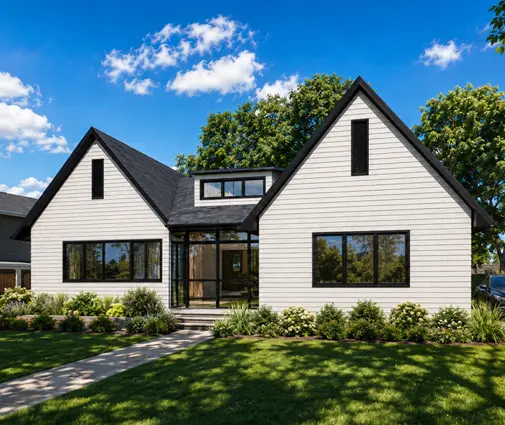
In a two-storey home, place the stove near the open stair so warm air can rise to the upstairs bedrooms. The 2,589 sq ft modern farmhouse with four bedrooms on two floors is a good example of that idea. Keep the bedroom doors undercut or add transfer grilles. Some owners also run the HRV or a small fan on recirculation to move heat around, which an open-concept layout makes much easier.

Is a basement wood stove a good idea?
It can be, but it is usually less effective than a main-floor stove unless the basement is finished and well connected to the floor above. Heat rises through stairs and floor openings, but a closed stairwell door stops it cold.
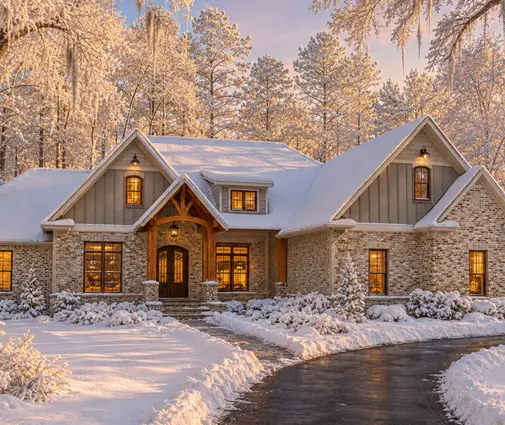
A basement stove works best in a smaller bungalow with an open stair, such as this 1,714 sq ft four-bedroom Craftsman one-storey with a basement. Wood storage and ash removal are easier down there too. Remember that a finished basement needs the same clearances, outdoor air and smoke and CO alarms as any other floor. Browse more house plans with a basement if this is your plan.
Do I need a permit and an inspection?
In most municipalities, yes. Installing a wood-burning appliance and chimney is building work, so include it in your building permit drawings. The appliance model, chimney system, clearances and outdoor air route should all be shown.
Your home insurer will usually want proof of a proper installation. Outside Quebec this often means an inspection by a WETT-certified professional; in Quebec, insurers typically look for an APC-certified installer or inspector. Call your insurer before you buy the stove. Some charge a higher premium for wood heat or require annual chimney sweeping.
Can my municipality restrict wood burning?
Yes, and more of them do every year. Montreal, for example, allows only certified low-emission appliances. Some communities in BC and elsewhere limit burning during air-quality advisories or set rules for new installations.
Rural acreages and cottage country tend to be more permissive, but don't assume. Check your municipal bylaws and any regional air-quality rules before you finalise the plan.
Wood, gas or electric fireplace: which costs less and is more efficient?
Wood is cheapest to run if you have access to firewood. Gas is the most convenient, and electric is cheapest to install but mostly decorative. Approximate 2025 ranges, installed, vary widely by region and finish:
| Type | Installed cost (2025, CAD) | Typical efficiency | Notes |
|---|---|---|---|
| Certified wood stove | about $5,000–$12,000 with chimney | roughly 65–80% | Works in power outages; needs wood, sweeping, outdoor air |
| Direct-vent gas fireplace | about $4,000–$10,000 | roughly 70–85% | Sealed combustion suits tight homes; needs a gas line or propane |
| Electric fireplace | about $500–$4,000 plus build-out | 100% at the unit | No venting; resistance heat costs more per BTU than a heat pump |
Firewood prices vary a lot by province and supplier, so get a local quote. In a home already heated by a heat pump, a wood stove is mostly backup heat and ambiance. That backup matters on an acreage, where winter power outages can last days.
What size of stove does a high-performance home need?
A smaller one than you think. A well-insulated new house with high R-values and an HRV may need only a fraction of the heat an older house of the same size needs. A large stove will either overheat the room or be run smouldering, which wastes wood and builds creosote.
For a single-storey home of around 2,000 sq ft, like this 2,168 sq ft three-bedroom Scandinavian-style one-storey or the rustic 2,109 sq ft four-bedroom bungalow with a basement, ask your designer for a heat-loss calculation. Then choose a stove whose low-burn output matches it. You can see more single-level layouts among the one-storey plans.