A familiar story from permit counters on Vancouver Island goes like this. A family arrives with finished drawings that include a gas furnace, a gas tank water heater and a linear gas fireplace in the great room. The plans examiner tells them the municipality has adopted the top level of the Zero Carbon Step Code, so none of those appliances will pass. The mechanical design gets redone, the electrical panel gets bigger, and the permit waits a few more weeks.
That situation is easy to avoid if you know which way your municipality leans before the drawings are finished. Combustion heating is not banned across Canada. In a growing number of places, though, it is restricted, priced out, or on a published timeline to disappear. This comparison sets natural gas (and propane or oil where relevant) against an all-electric home, one criterion at a time.
Gas versus all-electric at a glance
| Criterion | Gas or other fuel | All-electric |
|---|---|---|
| Permit risk in 2026 | Refused in many BC municipalities, Vancouver and Montreal; oil not allowed for new homes in Quebec | Accepted everywhere |
| Space heating, installed (new build, 2025–2026) | Furnace plus central A/C: about $7,000–$13,000 | Cold-climate ducted heat pump: about $13,000–$25,000 |
| Domestic hot water | Tank or tankless: about $2,500–$5,500 | Heat pump water heater: about $3,000–$6,500 |
| Cooking and fireplace | Gas range and fireplace, where still permitted | Induction range, electric or wood-burning fireplace |
| Utility connection | Gas service line and meter, sometimes costly on rural lots | Electrical service sized up, often 200 A or more |
| Mechanical room | Venting and combustion air required | No flue, but an outdoor unit and space for a larger water tank |
| Long-term outlook | Rising carbon costs and tightening local rules | Lines up with where codes are heading |
All figures are rough 2025–2026 ranges for a typical detached house. Quotes vary a lot by region, house size and contractor, so get at least two before you commit.
Where combustion is still allowed
British Columbia moves fastest. The province created the Zero Carbon Step Code as an option for local governments, with emission levels that run from simply measuring carbon up to a near-zero top tier. A long list of municipalities, many in the capital region and around Metro Vancouver, already require that top tier for new single-family homes. In practice that rules out a gas furnace and a gas water heater. The province has also said it intends to bring every new building to zero carbon by 2030, so even a town that still allows gas today may not in a few years.
The City of Vancouver has its own bylaw. For several years now it has required zero-emission space heating and hot water in new detached houses and duplexes. Rules for gas ranges and fireplaces have been looser, but they are under review, so ask the city before you run a gas line to the kitchen.
In Quebec, oil heating appliances cannot be installed in new construction. That provincial rule has applied since the end of 2021. Montreal goes further: its bylaw on combustion appliances in new buildings started with smaller residential buildings in 2024. Elsewhere in the province, gas is still allowed, but electricity is cheap and the default choice in most new builds.
Ontario has no ban. The Toronto Green Standard pushes new development toward low emissions, but it applies mainly to projects that go through a planning application, such as subdivisions and larger sites. A single custom house on an existing lot often falls outside it. Other places are changing how gas service is paid for, which affects the cost of connecting a new house even though the furnace stays legal. Ontario has been debating who should pay for new gas connections, and builders in several regions report higher connection charges.
Verdict: in much of BC, in Vancouver and in Montreal, all-electric is mandatory, not optional. Elsewhere, gas is still legal, but always confirm with your building department before the mechanical design is final.
Space heating
Cold-climate air-source heat pumps now deliver useful heat well below −20 °C. In the Prairies and northern Ontario, designers often add electric resistance backup in the air handler for the coldest week of the year. Ground-source systems cost far more to install, often $30,000 to $60,000 with the loop, but they keep their efficiency in any weather. A gas furnace with a separate A/C is still the cheaper system to buy, and many Canadian builders know it best.
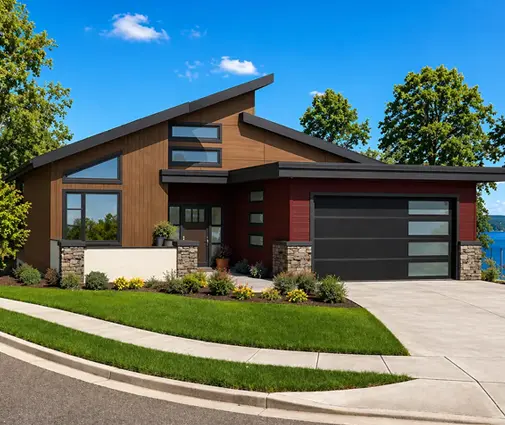
The house itself matters more than the equipment. A compact, well-insulated bungalow such as this five-bedroom one-storey on 1556 sq ft has a heat load small enough that a modest heat pump can carry it. A much larger home such as this 4295 sq ft two-storey needs careful zoning, and possibly two outdoor units.


Verdict: a heat pump costs more upfront but handles both heating and cooling. Gas only wins on first cost, and only where it is still allowed.
Hot water
A heat pump water heater pulls warmth from the surrounding air. That is why it works best in a basement that stays above roughly 10 °C, where it also lightly dehumidifies. It recovers more slowly than a gas unit, so a busy family usually chooses a larger tank, 65 to 80 US gallons. With a big household and several bathrooms, compare the recovery rate, not only the tank volume.
Verdict: electric is a close match for gas here. Plan floor space and a condensate drain for it.
Cooking and the fireplace
Induction has won over many cooks who once insisted on a flame. It boils water faster than gas, it is easy to clean, and it does not add combustion by-products to an airtight house. Expect to pay about $1,500 to $4,000 for a good freestanding induction range in 2026, which is roughly what a comparable gas model costs. A direct-vent gas fireplace can run $4,000 to $10,000 installed. Electric units cost a fraction of that and need no chimney, though the flame effect is not for everyone. Rural owners on acreages sometimes choose an EPA-certified wood stove instead. Check local rules first, because some urban areas restrict wood burning too.
Verdict: if your town allows a gas range or fireplace, it is a lifestyle choice. Induction and electric fireplaces are the safe default.
Upfront and running costs
On the purchase price, gas usually comes out ahead by $5,000 to $15,000 across heating, hot water and cooking. That gap shrinks once you leave out the A/C (the heat pump already cools), the gas service connection, the venting and the gas meter's monthly fixed charge. Operating costs depend on the province. In Quebec and Manitoba, with low hydro rates, electric usually costs less to run. In Alberta and Saskatchewan, where gas is cheap, a heat pump may cost more per year, unless you add solar or very good insulation. Rebates and low-interest financing come and go, so check what your province and utility offer when you budget.
Verdict: gas is cheaper to install. Over the life of the house, the two are close in most provinces, and electric is cheaper where power is cheap.
The mechanical room and the electrical service
Without combustion, the mechanical room needs no flue, no fresh-air duct for burners and no clearances for venting. In exchange it has to fit an air handler, a larger hot water tank, an HRV or ERV, and a panel big enough for everything. A 200 A service covers most all-electric homes under about 2,500 sq ft. A larger house, an EV charger or a heated garage can push you to 320 or 400 A. Moving up from 200 A in a new build can add roughly $3,000 to $8,000, plus utility fees. Ask your electrician for a load calculation early.
Verdict: all-electric frees you from vents and combustion air, but the electrical service needs planning from day one.
How the choice changes the plan
The outdoor unit of a heat pump needs a spot with good airflow, raised above the snow line and away from bedroom windows. A side yard next to the mechanical room works well. In a home with a full basement such as this four-bedroom bungalow with a lower level, the basement is a natural place for the water tank and the air handler, and short line sets save money. Browse our house plans with a basement if that layout suits your lot.
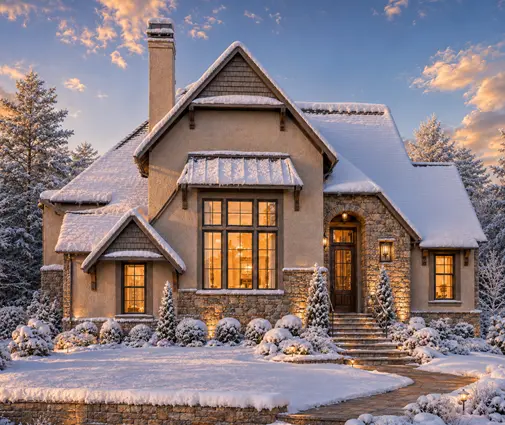
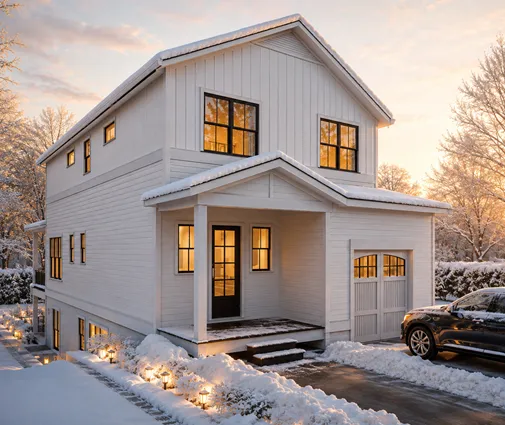
On a slab or crawlspace, look for a utility room near the centre of the house. This ranch-style home of 1706 sq ft keeps its laundry and service areas close together, which makes a good starting point. In a vertical design such as this three-level farmhouse on a compact footprint, you may want a second small air handler upstairs rather than long duct runs. For a cottage-style home like this storybook two-storey, a ductless mini-split on each floor can replace ducts entirely.

Verdict: decide the fuel before the final drawings, not after. It changes where the mechanical room goes, the outdoor clearances and the size of the panel.
Who should choose what
- Building in Vancouver, Montreal or a BC municipality at the top Step Code tier: go all-electric from the first sketch. Gas is not an option for heat or hot water.
- Building in the Prairies, where gas is cheap and winters are long: gas is still legal and economical. A cold-climate heat pump with backup is worth pricing if you want to be ready for future rules.
- Building in Quebec or Manitoba: all-electric usually wins on running costs. Oil is out for new homes in Quebec.
- Building a single house in Ontario: gas is allowed, but check the connection cost and look at a heat pump with a gas backup if you want both.
- Building on a rural acreage with no gas main: compare propane against a heat pump. The tank, deliveries and price swings often tip the decision toward electric.
- Planning a large or multi-storey home: whatever the fuel, zone the heating, and confirm the electrical service size with an electrician before you finalize the two-storey plan you choose.
Rules change quickly, so treat this as a starting point. Call your municipal building department and talk to your designer or mechanical contractor before the drawings are final.