Many families size their new home around the construction quote and the mortgage approval, then discover after the first winter that the house has a second budget of its own. Gas or hydro, the water bill, the municipal tax notice, the insurance renewal and the slow wear of shingles and appliances add up to a sum that, for a typical new build, sits somewhere between the price of a car payment and a second mortgage. The good news is that much of it is decided on paper, long before the foundation is poured.
Below are ten items worth estimating while you still have a floor plan in front of you. All figures are rough yearly ranges in Canadian dollars as of 2025, for three reference sizes: a compact 1,200 sq ft home, a mid-size 2,000 sq ft family house and a larger 3,000 sq ft one. Rates vary a lot between provinces and even between neighbouring municipalities, so treat these numbers as a starting point and confirm local rates with your utilities and your town hall.
1. Space heating: the bill that moves the most
A new house built to current code, with an airtight envelope and an HRV, heats far more cheaply than its size suggests. With a natural gas furnace in a central Canadian climate, expect about $800 to $1,100 a year for 1,200 sq ft, $1,000 to $1,500 for 2,000 sq ft and $1,400 to $2,100 for 3,000 sq ft, fixed delivery charges included. In the Prairies you burn more gas but often pay less per cubic metre, so the totals end up in a similar band.
A cold-climate air-source heat pump changes the math depending on what electricity costs where you live. In Quebec and Manitoba, where hydro rates are low, heating a 2,000 sq ft new home electrically can come in under a comparable gas bill. In provinces with pricier power, such as parts of Atlantic Canada, it may cost the same or a little more. Ask your designer for a heat-loss calculation before choosing: it is the number every quote should be based on.
2. Cooling and the shoulder months
Air conditioning is a modest line in most of the country. A central system or a heat pump in cooling mode typically adds $100 to $400 a year, more in southern Ontario or the Okanagan, less on the coast or in the North. Window placement matters more than people expect: a wall of west-facing glass can double the summer load of a bungalow. Overhangs, a covered porch and good low-e glazing are cheaper than oversized equipment.
3. Hydro for everything else
Lights, appliances, the range, the dryer, the HRV fan and your devices form a base load that exists whether you heat with gas or not. In 2025, plan on roughly $900 to $1,300 a year for a small house, $1,100 to $1,700 for a mid-size one and $1,400 to $2,200 for a large one. Electric vehicle charging in the garage adds several hundred dollars more, though it replaces fuel costs. Time-of-use pricing, where your province offers it, rewards running the dishwasher and laundry in the evening.
4. Water, sewer and the acreage alternative
Municipal water and wastewater charges depend more on how many people live in the house than on its square footage. A family of four in a Canadian city commonly pays $900 to $1,700 a year, and some municipalities bill stormwater as a separate fee. Every extra bathroom tends to bring a little more use, so a plan with four full baths will not necessarily raise the bill, but it rarely lowers it.
On a rural acreage there is no water bill, but there is a well pump on your hydro meter, water testing a few times a year and a septic tank that needs pumping every three to five years, often in the $300 to $600 range per visit. Set aside a reserve for eventual repairs to the pump or the septic field.
5. Property tax: set by your address, scaled by your house
Property tax is usually the largest running cost of all, and the one you control least. It is the assessed value multiplied by the local rate, and rates range widely: a large city in British Columbia may charge well under 0.5% of value, while many towns in Manitoba or New Brunswick charge more than 1%. As a broad 2025 picture, a new 1,200 sq ft house often lands between $3,000 and $5,500 a year, a 2,000 sq ft one between $4,500 and $8,000, and a 3,000 sq ft one from $6,500 to $11,000 or more.
Because assessors look at finished area, a larger plan, a finished lower level and an extra garage bay all push the number up. Ask the municipality for its current mill rate and look at the tax history of recently built homes on the same street.
6. Home insurance
Premiums have risen steadily, driven by water damage, hail and wildfire claims. For a new detached house, a reasonable 2025 range is $1,300 to $2,000 a year for 1,200 sq ft, $1,700 to $2,600 for 2,000 sq ft and $2,200 to $3,500 for 3,000 sq ft. Hail-prone parts of Alberta and wildfire-exposed areas in BC sit at the top of those ranges or above them. Sewer backup and overland water coverage are often optional add-ons; with a basement, they are worth pricing early.
A new build earns some advantages: modern wiring, a new roof and a sump pump with a backup can all help when you request quotes. Get two or three before construction is finished so the cost is known.


7. A maintenance reserve, even for a brand-new house
The first years are quiet, and the provincial new home warranty covers defects for a set period. Still, the furnace filter, HRV cores, caulking, gutters and the first appliance repairs arrive sooner than expected. A common rule is to save 0.5% of the home's value per year early on and move toward 1% after about ten years, when shingles, the water heater and the heat pump approach the end of their life. For a 2,000 sq ft house, that means roughly $2,500 to $4,000 a year in the early period.
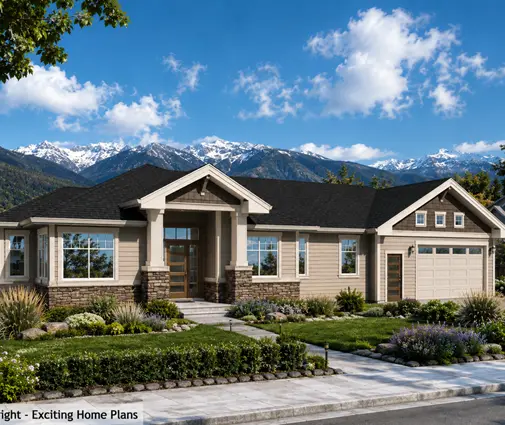
Simple forms age gracefully. A rectangular three-bedroom ranch of 1,577 sq ft with a basement has fewer valleys, corners and roof penetrations to watch than a home with several wings and dormers.
8. The heated garage
Heating an attached garage to keep it above freezing is a real comfort in a Canadian winter, and it is also a real cost. A two-car garage held at around 10°C with a gas unit heater can add $250 to $600 a year, more if the overhead door is poorly sealed or opened often. Insulate the walls and ceiling to the same standard as the house, choose an insulated door with good weatherstripping and use a programmable thermostat. If you only want to avoid frozen pipes and a cold car, a low setpoint does most of the job.
9. The finished basement
Below grade, the earth keeps temperatures steady, so finishing the basement increases the heating bill less than adding the same space above ground. Expect perhaps $150 to $400 more a year for heat and lighting once a lower level becomes a family room and guest bedrooms. The larger impact is on property tax and insurance, since the finished area raises the assessed value.
A bungalow with a full lower level is a good way to get family-size living space while keeping running costs close to those of a smaller house. Examples include a Craftsman bungalow of 1,491 sq ft with five bedrooms, a 3-bedroom one-storey plan of 1,575 sq ft and a 4-bedroom bungalow of 1,714 sq ft, all designed with a basement. More options are in the house plans with a basement.
10. New build versus resale: the yearly gap
A house built in the 1970s or 1980s, with thin walls, older windows and a mid-efficiency furnace, can easily cost 40% to 60% more to heat than a new home of the same size. Add a roof, windows and furnace that will need replacing within a few years, and a resale home's true yearly cost often exceeds the lower purchase price saving. A new build built under the BC Energy Step Code or a comparable efficiency program in another province can widen the gap further. An EnerGuide evaluation gives a clear rating to compare.
Size still matters most, though. A single-storey plan of 2,109 sq ft with four bedrooms and a basement will cost noticeably less to run each year than a two-storey Craftsman of 3,273 sq ft, even if both are built to the same standard. Browse the one-storey house plans if a compact, efficient layout fits your family.

What it adds up to
Putting it together, an efficient new home in 2025 costs very roughly:
- 1,200 sq ft: about $8,500 to $14,000 a year, or $700 to $1,150 a month
- 2,000 sq ft: about $12,000 to $19,500 a year, or $1,000 to $1,600 a month
- 3,000 sq ft: about $16,000 to $27,000 a year, or $1,350 to $2,250 a month
Property tax and insurance make up the largest share, and both scale with size and value. Heating, the most discussed line, is the one a good plan and a well-built envelope can shrink the most. Before you commit to a design, build these numbers into your monthly budget, check the local tax rate and get an insurance quote. The square footage you choose today will show up on every bill for the next thirty years.